

This Monday, the MAHA movement held its annual ‘MAHA Summit’, where healthcare companies paid up to $300,000 to be a sponsor and speak on a panel, often alongside government officials from the Department of Health and Human Services (HHS). They also got an invite to an intimate dinner with Secretary of Health RFK Jr and sidekick Dr Oz.
The first panel was on psychedelics. It was chaired by Matt Zorn, Kennedy’s ‘psychedelic czar’ and the lawyer who drafted President Trump’s Executive Order on psychedelics, and featured the CEOs of three psychedelic start-ups hoping for FDA approval in the coming months: Rob Barrow of LSD company Definium, Kabir Nath of psilocybin company Compass Pathways, and Michael Halstead, CEO of psilocybin company Helus. According to Bloomberg, they were all paid sponsors of the summit, so they paid to be on stage and to get access to RFK and other HHS officials.
Now listen to what they say when Matt Zorn asks them about the safety of psychedelics. The first speaker to answer Matt Zorn nis Rob Barrow of Definium, the second is Kabir Nath of Compass.
So, according to two of the leading CEOs in the industry, taking psychedelics is basically like receiving an anesthetic. You won’t feel any lasting effects once the trip is over - no lasting negative effects anyway. Absolutely no risks of any prolonged difficulties after the trip. Just like having a tooth pulled, you could say.
Now watch this - this is a participant in one of Compass’ trials, talking about the prolonged difficulties she experienced after the trial, to the point of suicidal ideation.
As Maryam says, hers is not a unique case. Between 5% and 35% of users of psychedelics report feeling worse after a trip, depending on the substance (Rockhill 2026), while 9% report moderate-to-severe difficulties lasting over a month (Robinson 2026). Adverse events figures are undoubtedly lower in clinical settings, but they are not zero - see our article on severe adverse events in Swiss clinical program.

Are the American people being sold a lie by the psychedelic industry? Are we five or ten years away from an entirely predictable psychedelic class-action law-suit?
Psychedelic oligarchy
There have been concerns for the last two years that the psychedelic movement - both companies and multi-millionaire philanthropic backers - might try to buy their way to approval from the Department of Health and Human Services.
When the FDA advisory committee rejected Lykos in 2024, despite philanthropists spending over a million dollars on PR that year to support its bid, it was a serious blow to the psychedelic movement. But when Trump won the 2024 election and Robert F. Kennedy was appointed Secretary of HHS, there was real optimism among the psychedelic elite that HHS support and FDA approval for psychedelics could basically be bought…even for Lykos, now renamed Resilient, which is expected to refile its rejected application to the FDA with a bit of third-party data added.
If you’re a supporter of psychedelic legalization, you might say, well so what? These drugs are proven effective, they’re desperately needed, and now they will finally get approved. If money was spent to ensure MAGA / MAHA political support, it was well-spent.
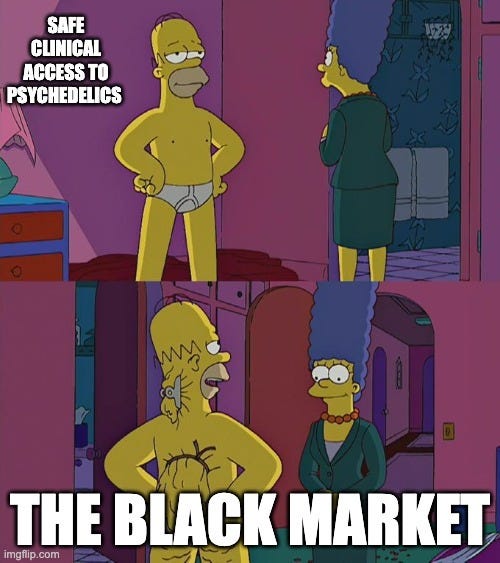
But in the acceleration to market, will the risks of these drugs be properly communicated to the American public? Because the real impact of the Trump government’s enthusiastic support for psychedelics will not be what happens in medical clinics. It will be in the much bigger black market. FDA approval and the support of the federal government will give a massive signal to the public that these drugs are safe, and we can expect unregulated use to surge, even more than it did last year when psilocybin use went up by 23%.
That’s why it really worries me that the CEOs of psychedelic start-ups, having stripped therapy from their treatment and reduced it to ‘psychological support’, are now seriously trying to claim that being given a psychedelic is just like receiving an anesthetic, with no risks at all of any prolonged psychological difficulties.
That is flat-out false. Maybe no prolonged serious adverse events were reported in Definium’s Phase 3 trials - we’ll see when the full data is published. But therapists working on psychedelic trials told me that monitoring of psychological adverse events is weak and inconsistent on many trials, and drug companies have a lot of license on what they report, and whether they attribute an AE to the drug. There is a 10-year history of psychedelic trials minimizing and hiding adverse events, as Olivia Goldhill chronicles in her upcoming book Empire of the Mind.

And it’s dangerous to suggest there’s zero risk of prolonged difficulties, because everything that the industry and the federal government say on psychedelics will affect what people take not just in the clinic but in unregulated spaces.
The psychedelic industry and HHS display a wilful naivete about how easy it will be to control these substances and limit ‘diversion’ (ie people taking these drugs outside of medical settings). Definium’s Rob Barrow said at the MAHA Summit: ‘None of us have an interest in this spilling outside of medicine in the ways it has in the past’.
Spilling outside of medicine? My friend, they’re already spilled! Anyone can get LSD or other psychedelics delivered to their door in an hour.
There’s a similar wilful blindness to the reality of massive unregulated use of psychedelics in the new Congressional Report on Psychedelic-Assisted Therapy, produced by Pinney Associates. More below.
