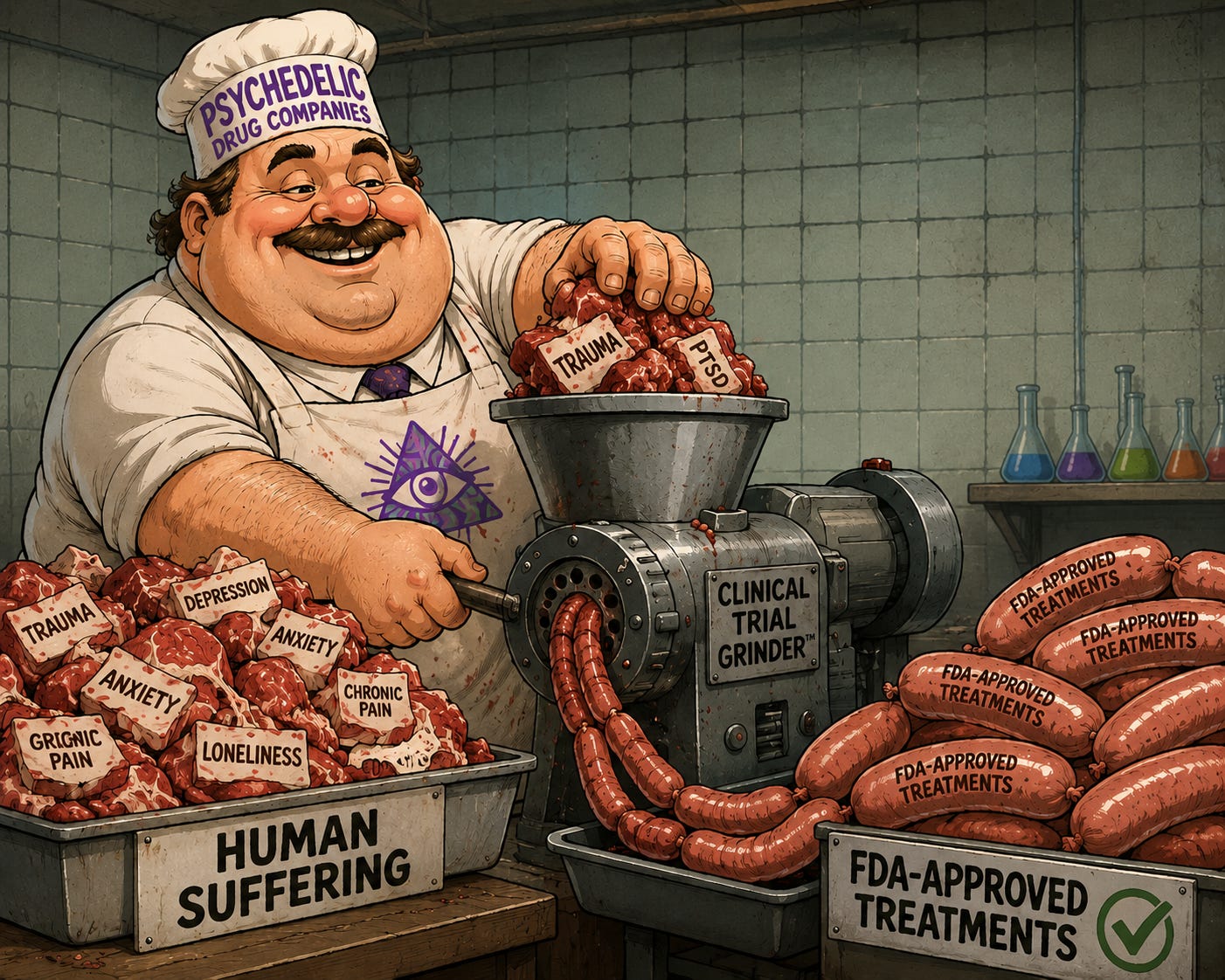
Therapists on psychedelic trials express concerns over safety and ethics
They deserve to be listened to
Psychedelic drug companies are suddenly doing great. The FDA is granting them National Priority Vouchers, President Trump has backed them from the Oval Office, stock prices have soared, big pharma is on a shopping spree. This is very good news for those with equity in psychedelic drug companies, and it’s a hopeful moment for those who believe in the medical potential of psychedelic drugs. But are products being pushed through the FDA machine in a way that could threaten patient safety, both in trials and potentially post-approval?
That’s the concern of some therapists working on these trials. Many of them are passionate about psychedelics, they’ve worked with them for years, they’ve worked on multiple trials with all the uncomfortableness of that experience, in service of the dream of legal psychedelic medicine. But some have concerns about how the dream is becoming a reality - through drug companies who are not part of psychedelic culture, led by pharma executives with no psychedelic experience and little understanding of the risks of psychedelics. Some of these therapists reached out to me to speak anonymously about their concerns, sometimes regarding specific trials, other times about concerns across multiple trials.
One therapist has worked on six clinical research trials, involving five different sponsors. They say:
What I’ve witnessed across six trials over three years is not a collection of isolated problems — it’s a system that is moving faster than its safety infrastructure can support. Vulnerable people are being enrolled with inadequate preparation, put through medically significant protocol requirements without adequate clinical support, and left without meaningful recourse when things go wrong. The training and supervision structures that should protect participants exist largely on paper. The informed consent process that should ensure participants understand what they’re entering is being treated as a formality. And underneath all of it is a field whose public narrative is dominated by hope and hype, with really no space for therapists to voice concerns.
Psychedelic trials are an awkward marriage of pharma culture and therapist culture. There can be a culture clash. One therapist, who has worked on multiple trials at four different trial sites over the last five years, says:
There’s an uncomfortable mix of the medical-biological model and subjective experiences. People at the sites don’t really get it, and the therapists coming in are like ‘we’re doing blood draws in the middle of a psychedelic experience? That’s nuts’. The sites and the sponsors want data. The therapists want to look after people, ensure they get the most from the experience , and often those things are at odds. Over the years, I’ve learned how to navigate that, and I’ve learned how to kind of talk the language of and take the perspective of the biomedical kind of people, and they’ve learned a bit about us. But you get these weird moments where the Principal Investigator is asking ‘what’s the adverse event that’s happened here?’ and the therapist is taking an IFS approach to ancestral trauma, and they both think the other one’s completely mad.
The power in the marriage has shifted over the years, and right now, it’s very pharma-centric, and therapists don’t have much of a voice. That’s partly a reaction to MAPS / Lykos’s failure to get FDA-approval in 2024, and the industry interpretation that this rejection stemmed partly from MAPS / Lykos’ over-emphasis on therapy.
MAPS: ‘therapy cult’?
MAPS in some ways was a therapist-led collective, founded by Doblin who always dreamt of being a psychedelic guide, and inspired by Stanislav Grof. The MAPS model of psychedelic-assisted therapy was two therapists sitting with a client. MAPS culture was connected to the world of underground therapy in which ‘the guide’ is an exalted shaman-like figure, like Stan Grof, Claudio Naranjo or Francoise Bourzat. Therapists on MAPS trials felt very supported and validated, they went on six-day group training retreats, there was a lot of esprit de corps and a fair amount of MDMA personal experimentation. One therapist who worked on the Phase 2 trial in 2016 says:
I really loved it, I loved the people that I worked with. I felt like I had found my people. There was a lot of passion and excitement. We thought we were doing something really innovative. It was very heart-centered. We received wonderful training on these six-day retreats where we were living together. But it gradually became more corporate and a very different vibe.
Then came the 2024 rejection by FDA, in which therapists and private practice trial sites were singled out for blame. The ex-MAPS therapist tells me:
The community of MAPS therapists is still reeling from the FDA rejection. We went in with so much trust and excitement. Now we feel like pariahs. We were all traumatized by what happened, and by Psymposia’s mission against us, and I don’t think we’ve recovered. Resilient has been strangely hostile to therapists who worked on the trials. They say they’ll only work with academic centres, and they want to minimize the psychotherapy component, like the other drug companies.
Post-Lykos: from therapist to facilitator to ‘monitor’
Other psychedelic drug companies took the message from the FDA’s rejection of Lykos: minimize the therapy part of psychedelic therapy, focus on the drug. One therapist who has worked on several trials tells me: ‘We went from being called therapists, to being called facilitators, to being called ‘monitors’. It feels like a demotion.’
As several recent papers have pointed out (such as Brusky et al 2026), companies like Compass have re-branded the therapy in psychedelic treatments as ‘psychological support’ , but it still looks an awful lot like therapy, and on the trials at least, it’s being provided by licensed therapists. But that may not be the case post-launch.
One clinical trial therapist tells me:
The public is being sold a story that these drugs don’t require psychotherapy, and yet these trials all employ psychotherapists and many patients require long-term psychotherapy. This story needs to be brought to light.
Another therapist shares this concern:
My main concern is companies (Definium, AtaiBeckley, and Compass) making inaccurate, disingenuous, and dangerous claims about their clinical trials having ‘no psychotherapy’. Compass and AtaiBeckley at least state they offer ‘psychological support’, Definium says not even that, just informed consent without preparation before dosing, safety monitoring without psychological support during dosing, and follow-up assessments without integration after dosing. Plenty has been written about if psychological support is actually therapy, but I can say from firsthand experience and from colleagues’ experience that the trials of all of these companies 100% involve therapy before, during, and after medicine sessions.
Max Wolff, a therapist and researcher who has been critical of the industry’s denigration of the therapy component of psychedelic medicine, tells me:
Therapists on clinical trials are in a classic double-bind. They are hired as therapists, because of their qualifications and knowledge as therapists, and at the same time they’re told not to provide therapy. They’re told only to ensure safety, never to promote efficacy, that’s another double-bind.
Downplaying therapy and calling it ‘psychological support’ or ‘monitoring’ can be defended as a necessary maneuver to get through the FDA hoop. But therapists are also expensive, and replacing them with less trained facilitators - nurses, say, or even coaches - would reduce the cost of the treatment. Many psychedelic drug companies are hoping their products can be offered in a similar manner to Spravato, in the same clinics - via a short session monitored by a nurse.
A British clinical trial therapist tells me:
If you look at AtaiBeckley’s investor presentations, they’re telling investors that DMT and 5meoDMT are like Spravato - two-hours, no therapy, just safety monitoring by a nurse. But 5meoDMT and DMT are not like ketamine. Nurses can do great work, but if traumatic content comes up like early trauma or ontological shock, that’s precisely the sort of content that only therapists are trained to handle.
The psychedelic industry is investing heavily in producing sticks of dynamite to clear psychic blockages and get people unstuck. But it’s not investing at all in post-explosion integration and stabilization. Maybe this will work out fine, maybe not.
Listening to trial therapists’ concerns
There is an association of psychedelic drug companies, an association of psychedelic pharmacists…but no association of psychedelic therapists. Nor are there many places for trial therapists to gather online to swap notes. But there is a value to listening to their views, while remembering there are other valid perspectives.
What I plan to do is (1) work with therapists to do a more formal academic survey of trial therapists’ concerns and (2) support trial therapists to set up an informal online peer group for them - if you’re a clinical trial therapist interested in either of these initiatives, get in touch.
In the meantime, below, in brief, are 10 concerns that trial therapists raised in interviews with me (I spoke to ten trial therapists, based in the US, Australia, the UK and Germany). An important point up-top - psychedelic drug trials are not uniform. Different drug companies take different approaches and have different emphases on therapy, training, supervision etc. Therapists speak glowingly of some, pejoratively of others. There are also different trial sites, with their own cultures. So none of these points will be true for all psychedelic drug companies in all contexts. In addition, I’m listing therapists’ concerns, but they also mentioned many positives and expressed a lot of hope about the future of psychedelic medicine.
Here are 10 concerns:
Some companies offer minimal therapist training
On some trials, there is inadequate screening and a pressure to recruit and get participants through the trials
On some trials, there is inadequate informed consent regarding the psycho-social risks of psychedelics, the demands of the clinical trial experience, and the risk of disappointment
Some participants are being destabilized through coming off SSRIs
On some trials, there is weak adherence to and monitoring of the therapy model or rationale
On some trials, there is weak monitoring and reporting of psycho-social adverse events
Some participants are destabilized on trials and need longer-term therapeutic support, which may not be available or affordable post-approval
There’s a lack of supervision or mentoring for trial therapists on some trials, which increases the risk of burnout
There’s a growing need for socio-cultural diversity in trial therapists, which will increase post-launch
Therapists have concerns over trials’ use of AI and the possible aim to replace therapists with AI
Some companies offer minimal therapist training
The training offered by psychedelic drug companies to clinical trial therapists ranges widely in length. Compass, for example, offers training lasting a few months, which includes live-action role-plays and feedback sessions. But other companies like AtaiBeckley (according to therapists) offer 6-8 hours of online videos. Is that going to be enough training for nurses, therapists and psychiatrists who have never worked with psychedelics before to safely prepare, sit with and support clients?
One therapist tells me:
Of the five sponsors I have worked for, only one required an in-person dosing observation before being qualified to lead a dosing session. Watching online videos does not prepare someone to hold a person with treatment-resistant depression through a high-dose psychedelic experience while they are six weeks off their SSRIs and possibly receiving placebo. The gap between what facilitators need clinically and what they receive puts participants at direct risk.
2. On some trials, there is inadequate screening and a pressure to recruit
One therapist tells me of their experience working at a Contact Research Organisation (CRO), which is a company that runs trials for multiple different drug companies:
The metrics at CROs are focused on getting participants through the trial. Sometimes, if you’re ineligible for one trial, the CRO will try to fit you into another trial. There’s a lot of money involved and pressure on recruitment. CRO companies are making a killing. So it’s really focused on recruitment. How do we recruit high numbers of participants? How do we just get them through? Let’s pump them through these trials. Integrity of care for people can be compromised
In some cases, therapists report participants coming for dosing sessions, where it emerges they have serious mental health conditions that didn’t appear in the screening - such as Borderline Personality Disorder, in one example. In another example, a participant passed all the screening for a healthy normals Phase One trial, but turned out to have severe dissociated trauma that came to the surface during the session. Screening can also be cruelly arbitrary - participants can be screened out if their depression drops the day before dosage, or even if they have a cigarette in the days before dosage.
3. On some trials there is inadequate informed consent regarding risks
One therapist says:
Informed consent failures — this is the foundation everything else rests on. Participants are not meaningfully consenting to what they’re entering into. They don’t understand the risks of psychedelics, the risks of SSRI washout, the placebo possibility, or that their sessions are being recorded and AI analyzed. In a desperate, vulnerable population, this isn’t a paperwork problem — it’s a violation of a fundamental research ethics requirement that federal regulations explicitly mandate as a process, not a signature. Participants may be given the informed consent form (IFC) as part of a stack of papers to sign. Participants are not getting anyone to sit down with them to go over the risks and discuss. The Principal Investigators of the studies I have worked with do not seem to understand the risks themselves.
Therapists mention lack of informed consent around the demands of the clinical trial experience. One therapist says:
People have all these notions of what psychedelic experiences are like. And the fact of the matter is, in a clinical trial, this setting and the constraints of a trial are so different. There’s a huge amount of stress on the client leading up to dosing. Multiple clinic visits, time off work. Clients aren’t always prepared for this.
Therapists feel there is a lack of informed consent around the risk of disappointment, if either the treatment doesn’t work as well as participants wished, or if they receive the placebo dose. One therapist reached out to me to complain that Reunion, running a trial of psilocybin for people with terminal illnesses, offered half of participants the control / placebo dose, and no future opportunity to get the active dose. This seemed ‘inhumane’ to the therapist, especially with such a vulnerable population. I reached out to a member of Reunion’s scientific advisory board to ask them to nudge the company on this, and apparently Reunion will give all participants the opportunity to receive the active dose in future trials.
Participants are not always properly informed of the risk of being destabilized or of unexpected personality shifts. In at least one case, that’s led to litigation. A therapist tells me:
I have one client who had a Serious Adverse Event in a Phase One trial of healthy normals. They have had a really, really bumpy time and I’ve been working with them for a while. They described their experience as a personality transplant - they went from an extremely high-functioning person to relationship breakdown, terror states, resurfaced trauma. None of it showed up in screening before, because they weren’t depressed or anxious, they had structural dissociation. And they feel that there wasn’t proper informed consent from the drug company, so there is ongoing litigation on that.
In another case, on an Usona trial, one participant left her marriage after dosing and became a lesbian. There was discussion on whether such a sudden unexpected life-change should be registered as an adverse event (it wasn’t). Certainly, participants should be warned: this treatment could lead to sudden, major, unexpected personality-changes and life-changes.
There is also a lack of preparation on some trials, according to therapists. One therapist who worked on AtaiBeckley’s DMT trial says:
We meet with the client the day before dosing for one prep session. And this is DMT, we’re talking about potentially one of the most intense experiences, and there’s no therapeutic rapport established.
4. Some participants are being destabilized through coming off SSRIs
One therapist tells me:
SSRI washout causing harm including suicidal ideation (SI) — this is the most acute clinical harm I’ve witnessed directly. Three out of 8 participants experiencing SI as a result of protocol-required washout combined with placebo disappointment or non-response is a serious safety signal. These are people who came in already at the end of their rope, made more vulnerable by the trial design itself, with inadequate support structures to catch them when things go wrong.
This therapist adds:
I had a participant who qualified for the study after months of screening, went off his SSRIs for the study, and the day before his dosing was so severely depressed that he didn’t qualify to dose. He was released from the study. No follow-up, no support. This participant became suicidal, felt rejected, hopeless. He had spent months hoping this dosing would treat his life long depression. But because the participant was no longer in the study, there was no support provided for them.
5. There is wide disparity in the quality of therapy adherence-monitoring
On this topic I noticed a divergence in therapists’ opinions. Some therapists did not like how directive drug companies could be over what therapists should say and how they should behave during sessions - they felt this did not allow natural rapport to emerge. On the other hand, other therapists felt that some drug companies just promoted ‘non-directive therapy’ or ‘the inner healing intelligence’, or didn’t offer much guidance at all, creating a vacuum where therapists could bring in many different approaches. One therapist says to me:
There are successful scientific trials of psychotherapy, but they require standardisation and monitoring of adherence. How do you know if the therapy works unless it’s consistently applied across the participants, and you have something like a fidelity checklist? What happens instead is therapists bring whatever approach they want into that vacuum, so one person might be schema-trained and they’ll start talking about parts, the other person might be IFS trained, and are talking about parts in a different way, another person might be ACT trained, so they’re going to be talking about resistance and cognitive diffusion…It’s not a scientific trial of one psychotherapeutic approach.
In the words of another therapist:
In one study, therapists used whatever modalities they chose, with no oversight or monitoring, which means these aren’t controlled trials in any meaningful sense. The intervention is undefined. This is both a research integrity problem and a safety problem, because without consistency there’s no way to know what participants are actually receiving or whether it’s harmful.
There’s also a lot of disparity in how therapists react to ‘challenging experiences’. One therapist tells me:
I’ve had a fair number of clients who have challenging experiences and they work through them. But I’ve noticed other therapists or Principal Investigators who administer benzos or other ‘rescue medications’ if a person becomes highly anxious. There are huge differences depending on the personality of the therapist - some are more quiet, others more hands on. I know one who sits right by the client, staring at them.
6. On some trials there is weak monitoring and reporting of psycho-social adverse events
One therapist who has worked on multiple trials says:
How it should go is that, after a dosing session, the therapist meets with the Principal Investigator to go over everything that happened, and so that the PI gets to determine what’s an adverse event and lets the sponsor know. But in my experience, the PIs aren’t really involved. These research sites get these trial contracts, and they just have to put a PI down on paper, but sometimes on dosing days, the PI isn’t even on site. No one seems to be doing any due diligence of seeing what happened. I didn’t even get much training on what’s an adverse event, how to report it.
Another experienced trial therapist says:
The bar for reporting a serious adverse event is very high - it’s death or functional incapacity. The ability to capture psychological harms is not really there in the system. It’s a lot of biomedical pharma people, they’re not interested in subjective experience. They’re interested in what’s happening to your heart-rate, what’s happening in your blood. A lot of the senior executives in these companies have never taken a psychedelic and have no real interest in the psychedelic experience or the possible psychological side effects.
This therapist adds that the time-frame within which adverse events are monitored is often quite short - just 30 days or so - while serious harms can unfold over a longer time frame. Another therapist says: ‘I know of two instances where people took psychedelics recreationally and then spiralled and eventually took their life, but the suicide was several months later.’
Where trials do measure psychological harms, sometimes they do so in an intrusive way. One therapist complains about a suicidal ideation scale, whereby a participant is repeatedly asked whether they want to harm themselves, during and after the psychedelic experience. He says: ‘I took part in a Phase One trial as a participant, and it was genuinely off-putting to be repeatedly asked if I intended to harm myself while I was tripping.’
7. Longer-term therapeutic support is sometimes necessary for trial participants, but may not be available or affordable for patients post-approval
Several trial therapists say that psychedelics can operate like a Pandora’s Box, opening up wounds and bringing issues to the surface, in a way that is not always resolved within the time-frame of the trial. In some cases, participants need longer-term therapeutic support. If they request this, drug sponsors will sometimes pay for it. But not always - there are cases where participants have had to spend thousands of dollars trying to recover after adverse events, and to add insult to injury, their adverse events weren’t even reported in the trial literature.
Many participants say they feel grief or abandonment when the trial ends and would like some continued support or community. One therapist says: ‘There isn’t adequate follow-up support. I worry about that lack of supportive spaces where people can talk about their experiences.’ Some CROs and research centres have occasionally and briefly run integration groups for trial participants, but nothing that has endured.
While some drug companies have made longer-term support available to those who need it, what will happen after these treatments come to market? While billions is being spent on drug development, there has been no investment made in finding out what helps people recover from post-psychedelic destabilization. Post-psychedelic destablization is not even a recognized mental health problem. This means it is unlikely a person who feels seriously worse after a psychedelic treatment will find the care they need, or that this care will be reimbursed by insurance.
One therapist says:
I think we can do better. If some of the huge profits that are going to be harvested by pharmaceutical interests could be reinvested into stabilization therapy research, at least we’d have a few evidence-based tools up our sleeve for picking up the fallout. But as things stand, it’s going to hit like a ton of bricks, and then it’s going to be local service providers and / or charities that are picking up like the fallout - we see that already.
8. There’s a lack of supervision and mentoring for trial therapists on some trials, and this can aggravate burn-out
Some sponsors reportedly do a good job at supporting trial therapists - interviewees highlighted Compass, Beckley PsyTech, Transcend Therapeutics and Cybin / Helus. But other sponsors offer little-to-no mentoring or supervision. One therapist says:
One sponsor uses a monthly email newsletter in place of supervision. Another sponsor has a monthly zoom call where forty therapists are on the call, several who are in distress and need consultation about a participant but there is not enough time on the call to get to every therapist who has a concern. Supervision is the mechanism by which clinical errors get caught, therapists get support, and participant safety concerns get escalated. When it doesn’t exist in any meaningful form, everything downstream is less safe. This is the structural failure that connects most of the other issues.
Another therapist tells me:
I’ve done some trials where it’s really been like a training ground for psychedelic therapy, where there’s incredible feedback between the therapy team, the supervisors (who are external to the trial and independently-funded) and the sponsors. What we learn as a therapy team gets filtered back into revisions in the protocol - it’s exceptionally good practice. And I’ve worked on other trials where there’s no supervision whatsoever, nothing. Beckley PsyTech was great, but since it’s been taken over by Atai, it seems to be a race to the bottom, with all the supervision and mentoring stripped out.
Lack of mentoring, supervision and support can exacerbate therapist burn-out. One therapist says:
For about a year, all I’ve been doing is dosing. I’ve pushed myself. I’ve had weeks where I’ve done three dosings, I may have had a week where I did four in a row, which is far too many, I’ve hit a burnout point myself, so it’s something to be mindful of. I’ve seen young people quit because it can just be really intense. You’re suddenly transported to the most traumatic moments in people’s lives. And you absorb so much and hold so much from a participant’s experience. It builds up. Sometimes people in their early or mid 20s, they’re just not ready, they don’t have the clinical or life experience to sit with difficult material.
9. There’s a need for more cultural sensitivity to match therapists with participants
Therapists also expressed concern about building therapeutic rapport by matching therapists / monitors to participants - women participants might rather have a female therapist / monitor, for example. Psychedelic science is quite WEIRD - white, educated, high-income, spiritual-but-not-religious. As treatments roll out to more diverse populations, therapists think it will be helpful to have wider diversity among therapists. One British trial therapist tells me:
We’re now seeing quite diverse people in clinical trials - some of them are professional human trial participants, going from trial to trial for money. These are often economically vulnerable people, they’re often immigrants, English isn’t their first language. And yet in the therapy and psychiatry team, we’re almost entirely white.
A 2025 study by Grossman et al also found that the median income of trial participants up to this point ‘substantially exceeded the national median’. How will these treatments roll out to a much wider population of participants? How can lower-income people best be supported during and after sessions, especially if they’re not used to ‘therapy culture’ or New Age spirituality? How about participants from various religious groups? How can psychedelic medicine avoid being ‘luxury medicine’?
10) Therapists have concerns over trials’ use of AI and the possible aim to replace therapists with AI
Finally, therapists expressed concern and some derision for trials’ use of AI technology like Mpathic, supposedly to monitor adherence to therapeutic interventions. One therapist tells me:
Beckley Psytech used human adherence raters to review how well and accurately therapists provided the support model to patients on their trials and provide therapists with feedback. AtaiIBeckley has instead decided to use an AI software programme to do adherence rating on their trials (Mpathic). Mpathic is a standing joke amongst therapists working on clinical trials - it is so inaccurate that the feedback it generates is essentially useless, meaning that companies like ATAI that use MPathic are not actually measuring therapist adherence on their trials at all.
Another therapist says: ‘MPathic hallucinated in its transcript of one session - it suddenly started talking about a cookery show.’
A third therapist suspects that drug sponsors and MPathic are using AI to suck up human data from sessions in order to train the AI to, eventually, replace human therapists. This therapist says:
Participants’ most psychologically vulnerable moments are being recorded, AI transcribed, and fidelity scored by a commercial platform (Mpathic) that most participants don’t know exists. The hypothesis that this data is being used to develop commercial AI therapy products is worth investigating. The hallucination problem in AI transcripts also raises questions about data integrity downstream.
Conclusion
Obviously, therapists are likely to always think more therapy is necessary, and other perspectives need to be taken into account - drug companies, investors, regulators, psychiatrists, and especially participants or patients. I asked a couple of psychiatrists whether they thought the therapeutic component of psychedelic medicine is likely to be left out, and if that would put patients at risk.
Owen Muir, psychiatrist and Chief Medical Officer of Radial, says:
It’s an empirical question. The only way we can study the interface between psychotherapy and psychedelic compounds at scale is by getting them into the market, and we haven’t done that yet. As a psychiatrist who’s also the author of a psychotherapy textbook, I don’t believe psychotherapy will actually be cut out of the clinical care pathways for any of these drugs. The companies are not wrong that the FDA does not regulate therapy, that is the province of medical boards, and more importantly the domain of medical payers, who could choose to either pay for a compound with therapy or without. The pressure needs to be brought to bear to bring the data to healthcare payers to understand the value of psychotherapy in conjunction with psychedelics. At the end of the day, this is a payment model problem we need to solve. Patients need the best care, and the accounting for those better outcomes needs to be factored into the reimbursement for the treatments, And without that math none of this succeeds.
Peter Hendricks is a psychiatrist at the University of Alabama and Scientific Advisor at the Association for Prescription Psychedelics. He says:
If we acknowledge that psychotherapy must be provided by a licensed psychotherapist, then when these treatments are approved, they will be very costly. So if we want more people to have access, and if we want insurance to reimburse for these treatments, then I suppose we have to find a way to make the psychotherapy less expensive. So, in a way, I am supportive of this approach [of replacing therapy by psychological support] only because it feels like this would allow for more accessibility, and affordability. On the other hand, if we do indeed believe that for many people the experience can be challenging, if for many people it can lead to ontological shock, and some of the other things that you have shined a light on, we very likely do need licensed psychotherapists, that’s probably in the best interest of the patients, it’s probably how we minimize adverse events. But then it’s very expensive.
Hendricks hopes a range of options can be provided, some with more therapy built-in, others with less.
Some of my participants felt pretty much ready to go after one preparation session, then after the drug session, they would say ‘I’m good’ and they’re a little annoyed that they have to keep coming back for treatment. Maybe there’s some way we can identify people who need very little therapy, and who may not want it, to those who do.
One therapist agrees with this perspective:
There’s going to be some sort of distribution curve - some people are going to need a lot of preparation, a lot of support, a lot of therapy. Some people will probably need very little, and there’s even probably some where it’s better for people not to have any therapy.
Whatever the market ends up offering, certain takeaways remain: we need better informed consent regarding risks, better monitoring of psychological adverse events, better evidence-based treatments for those who get destabilized, and we need a better conversation between regulators, drug companies, psychiatrists, nurses, therapists and patients. Hopefully this article helps that conversation.


I'm on my way to Breaking Convention ...this report could not arrive at a better time and I'm sure will be a talking point today. and in the months to come. Bravo Jules! Again!