

This weekend, Matt Zorn, the US government’s psychedelic czar, spoke at the Horizons conference co-organized by Psychedelic Alpha founder Josh Hardman. Josh asked Matt about a story I wrote three weeks ago, asking if HHS was too cosy with psychedelic start-ups. My story included a clip from the MAHA Summit in which Zorn interviewed the CEOs of three psychedelic start-ups - Compass Pathways, Definium and Helus, all of them sponsors of the event, all of them seeking FDA approval in the next 12-24 months. Two of the CEOs declared on stage that there was basically no chance of extended difficulties after a trip - people come down, and go about their life like normal, just like after an anesthetic.
This is not true. Even in one of Compass’ own trials, 12 people out of 200 reported serious treatment-emergent adverse events, including one person who told the European Parliament she felt suicidal for weeks afterwards. Compass included her in its trial paper as a ‘non-responder’.
Matt and Josh discussed my article briefly on stage at Horizons (you can read their full interview here). Here’s one bit:
Josh Hardman: Jules Evans, who writes about psychedelic safety, wrote a week or two ago about you at the MAHA Summit, where some CEOs of psychedelic drug developers had paid to participate, and you moderated a discussion and said you’re very passionate about psychedelics. He asked whether that’s being a bit too cosy with industry, given you’re a government lawyer for the department that approves new drugs. What do you think of that?
Matt Zorn: If you’re not engaging the industry, you’re not doing your job. I like to think that, across HHS, we’ve created an unprecedented amount of opportunities for public engagement writ large. At the FDA Part 15 hearing, I believe only one of the drug sponsors spoke, and the rest of the speaking slots went to non-industry speakers. So I reject the premise that we’re being favourable to industry. We are engaging with industry, and we’re engaging outside of industry. I would think that’s what people want: broad engagement, no matter what the stripes are.
My article wasn’t criticizing Matt, who I like. But there is a general cosiness to the psychedelic lobby in the US federal government, from the president down, and especially in RFK’s Health and Human Services. I don’t think that’s deniable, and it’s not necessarily a bad thing. As I wrote in 2025:
RFK has appointed so many pro-psychedelic figures at HHS it’s startling to resemble Zendo Project. As one industry figure put it: ‘The HHS deck is well and truly stacked with pro-psychedelic figures. It’s almost too stacked, like, don’t show your hand so much.’
RFK’s HHS is very open to certain lobbies, such as the peptides industry or the flavoured vape industry, while being very hostile to other interests, such as vaccine companies. It’s not simply that psychedelic companies and ultra-wealthy psychedelic enthusiasts have bought the government’s support for psychedelic drugs, though there may be some of that. But RFK also seems to be a genuine fan of psychedelics, personally - they’ve helped his kids, several of his advisors are psychonauts, and he likes to take them himself, if reports are to be believed.
Anyway, this is the part of Matt and Josh’s conversation I want to highlight. Matt said this:
One of the things I’ve expressed concern about is that I think adverse events are going to be higher in the real world. Looking at the Oregon data on adverse events, I actually don’t think there are too many, but I think that could be a useful function.
He’s referring here to a very interesting recent paper published by the psychedelic research team at OHSU. It surveyed 346 Oregon psilocybin clients, from 24 service centres, enrolled November 2024 to March 2026. The survey found that 92% said they benefited from the psilocybin experience, and 59% ranked it among the ten most meaningful experiences of their lives. Only 1.2% needed emergency medical attention, and only 1.6% rated the experience as harmful, although this rose to 2.3% at the three-month mark. Nonetheless, extended difficulties were fairly high - 11.6% reported non-HPPD adverse events at the three-month stage, including worsening anxiety, worsening depression and new headaches. People still felt they benefitted overall, but the picture was complicated.
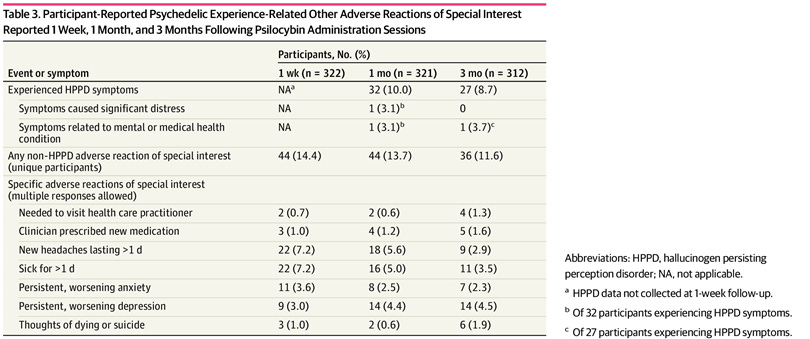
We should also note that, as far as I can tell, facilitators at service centres got to choose who they enrolled for the study. Still, the Oregon legal psilocybin program looks, on this evidence, to be pretty safe. That’s good news. But the expensive legal program is not where the action is in Oregon.
The real effect of the Oregon push to legalize supervised psilocybin sessions, paid for with state money and with millions of dollars in PSFC funding, was to boost demand in the underground. The Rocky Mountain Poison and Drug Service estimated that 90,000 people took psilocybin who wouldn’t have, due to the change in state law regarding psilocybin. The authors wrote:
an additional approximately 90,000 individuals in Oregon used psilocybin annually following passage of the ballot measure. This estimated number is larger than the number of people the Oregon Health Authority reports used regulated psilocybin services.
Only 5000 people used the state legal psilocybin program in 2025, so 95% of the impact of this legislative initiative was use outside the legal program, in recreational or underground or church contexts.
We don’t have a lot of data about outcomes in the unregulated market, but there’s some. Rocky Mountain, again, analysed the National Survey Investigating Hallucinogenic Trends. It found that psilocybin use in the US, which went up 23% last year, led to largely positive outcomes - 50% felt their mental health improved, versus 5% who felt it got worse. That’s pretty positive, and by far the best safety profile among psychedelic drugs (with ibogaine and 5meoDMT, by contrast, the same number felt worse as felt better).
But one point to take away from Oregon is that public health initiatives can’t just focus on legal supervised usage, because that (in Oregon at least) is only around 2-4% of total use. In Oregon, legal psychedelic initiatives end up boosting demand in the underground. And the same will occur nationally - the biggest impact of FDA approval will be to boost demand in the underground. It will be boom-time for dispensaries, illicit labs, churches and underground guides. I’m not saying that’s good or bad, it’s just a fact.
Matt Zorn made exactly the same point at Horizons:
I would encourage everyone to look at safety and adverse events carefully, because I think the greatest risk here is use outside the medical channels that results in adverse events, driven by FDA approval [my italics].
But then he says:
For the government’s sake, it’s about making sure that people use these compounds as prescribed and within indicated channels.
That is not going to happen. The price differential between legal and illegal psychedelics is going to be huge - it costs over $20,000 for legal psilocybin or MDMA treatment in Australia, versus nothing to grow or pick shrooms yourself, or maybe $20 to buy these drugs online, or maybe $200 for an underground guided session. Not to mention the speed-of-access differential: on the one hand, you order drugs online and get them delivered to your door that week; on the other, you go to your doctor, maybe you get prescribed to a psychiatrist’s clinic, maybe you get approved for treatment, then you go on a waiting list, go through all the paperwork, and then try to get your insurer to reimburse you.
Even with cannabis, where recreational use has been widely legalized and there is nothing like the price differential between legal and illegal products as there is with psychedelics, an estimated 75% of cannabis is still bought from illicit channels.
A public health response from the US government (or any other government) can’t focus on just legal medical use of psychedelics. It has to try and educate the public and reduce harms however and wherever the public accesses these drugs.
That was one of our main points in CPEP’s FDA comment:
FDA approval must be accompanied by public education on psychedelic risks in medical and non-medical settings
training for providers must include the nature, frequency and treatment of extended postpsychedelic difficulties, which most current programs omit
informed consent must cover the risk of feeling worse for weeks or months after psychedelic treatment, despite psychedelic CEOs recently denying this is a possibility
Secondly, public communication about psychedelics, especially from government sources but also from leading industry and media voices, needs to be honest about the risks of psychedelics, as well as the benefits. Those risks exist no matter what the context - we’ve reported on severe extended difficulties in the Swiss legal medical program, for example, and also in psychedelic trials.

This is what one patient who experienced a severe adverse reaction to legal MDMA treatment in Switzerland told us:
I don’t think words can truly convey the depth or quality of suffering that prolonged adverse effects from psychedelics can cause. For me, it was over a year of unimaginable hell, often staying alive only because I was in psychiatric isolation rooms or under extensive monitoring in hospital settings. There is a second kind of hell in enduring such profound suffering without knowing whether you will survive or remain indefinitely in that state. Even surrounded by professionals and loved ones trying to help, the uncertainty of facing something that seems beyond anyone’s understanding is terrifying, month after month.
Finding CPEP was a lifeline after four months of indescribable suffering. Through CPEP’s website, research findings and educational resources, conversations with CPEP staff, and the monthly support group, I discovered that I was not alone, that these adverse effects had been researched, and that people were willing to listen and understand. CPEP gave me context for an experience that had felt incomprehensible, and a tiny glimmer of hope when I desperately needed one. That hope helped keep me alive. I am still bewildered that I survived, and will be forever grateful to CPEP for being a light in the darkness.
The psychedelic industry and culture can afford to be honest about the risks - the risk profile for psilocybin and MDMA looks pretty good, better than SSRIs I would say, but when it goes wrong, it can go really wrong. Let’s learn about those cases of ‘unimaginable hell’, find out what helps people recover, and make sure the public knows there is a low risk of extended difficulties, but a risk nonetheless. And let’s have a plan for when things do go wrong.
It is not the adverse events that could derail the psychedelic movement - it’s the cover up.
After the paywall, Navy SEAL podcaster Shawn Ryan on how the psychedelic movement wants him to shut up about his bad trip; Krysten Sinema’s psychedelic romance turns into a bad trip; the recording of Matthew Watkins’ talk on AI gods / AI delusions; and a new podcast I’ve launched on Costa Rica. Plus, why the public spat between psychonauts Billy Bush and Amy Griffin is more than just high society tittle-tattle.
