

All drugs and treatments, including talking therapy, give rise to adverse events including negligence and abuse. That’s a sad fact. The challenge for psychedelic culture, especially the unregulated parts of it (ie 95% of the market) is to be transparent and accountable for adverse events, learning from them to make them less likely to occur, rather than hiding them. When the field lies to hide psychedelic harms, it creates a second wound for the victims and their loved ones.
Last month, ibogaine clinics in Mexico admitted to two instances of serious harm - a death at the Ambio clinic in Baja, and a ‘violation of trust’ at Transcend in Cancun. In both instances, the clinics put out press releases, which were followed by press releases from Americans for Ibogaine, an NGO campaigning for the legalization of ibogaine in the United States. Another ibogaine clinic in Mexico, IbogaQuest, admitted a fatality to us when we inquired about it.
The incidents are shocking, but at least the clinics admitted the harms (more or less, although Transcend’s statement is opaque about what exactly occurred). A spokesperson for Americans for Ibogaine tells me:
While AFI has no oversight or regulatory authority over clinics operating outside the United States, we believe transparency in this space is essential. Historically, when serious issues have arisen within the psychedelic healing ecosystem, they have too often been minimized or swept aside. We do not believe that approach serves patients, families, or the long-term credibility of these therapies. Openly acknowledging problems when they occur is how systems improve. Transparency allows people to make informed decisions, enables the broader field to learn from mistakes, and creates pressure for higher standards of care. In our view, meaningful change is driven by truth, not silence.
Learning from harms
Ambio is one of the leading ibogaine clinics in the world, and gets incredible media coverage from celebrities like Conor McGregor and from the recent Netflix documentary In Waves and War. It serves ibogaine and 5meoDMT to many veterans who come for treatment via VETS Solutions, a well-funded NGO.
In their press release, they say:
a patient recently passed away while participating in Ambio’s Detoxification Program…The increasing complexity of powerful synthetic opioids and numerous other additives that appear in street drugs introduce a complex and opaque set of variables that can be difficult to mitigate. Ibogaine has been presented as a potential solution to the opioid crisis, however there are complex systemic barriers to resolving these issues…we will be implementing changes to our Detoxification Program. These changes include enhanced screening protocols, longer program durations for detox patients, and a minimum 21-day stay for anyone consuming fentanyl prior to treatment.
Ibogaine acts as an amplifier of whatever drugs are in someone’s system, even coffee, so there needs to be a detox period to make sure all drugs are out of the client’s system. In this instance, it appears a new synthetic variety of fentanyl was not detected in the client’s bloodstream and was amplified by the ibogaine, leading to the fatality.
A spokesperson for the Global Iboga Therapy Alliance (GITA) says:
highly-potent synthetic opioids such as nitazenes and xylazine may be present even when neither the client nor the provider is aware. Unlike fentanyl, nitazenes are not reliably detected by standard toxicology screens, and while nitazene test strips are beginning to emerge, they remain inconsistent and limited in availability. This uncertainty must be assumed and planned for. Compounding the risk, many of these molecules are lipophilic, meaning they can remain in the body for extended periods, sometimes seven to fourteen days or longer. If ibogaine is administered too soon, opioid potentiation can occur, increasing the risk of respiratory depression and overdose.
Transcend Ibogaine is a US-owned clinic in Cancun, Mexico. Its statement reads:
On January 24, 2026, members of our clinical staff detected an irregular situation involving a patient during a session. Our team intervened immediately upon detection to ensure the patient’s safety. Medical attention was provided on-site, and the patient was subsequently transferred to a local hospital for comprehensive evaluation and continued care. The institution promptly notified the authorities. The practitioner is currently in custody and facing criminal charges.
Transcend did not reply to an emailed inquiry for more information. Americans for Ibogaine in their statement referred to the incident as a ‘violation of trust’.
Meanwhile, another Mexican iboga clinic - IbogaQuest in Tepoztlan - says there was a client fatality there last year. A spokesperson for IbogaQuest tells me:
At IbogaQuest, we have worked with ibogaine for 17 years as a small-scale clinic, offering one treatment week per month to a maximum of seven participants. Over those 17 years, we had no fatalities. In 2025, we experienced our first and only fatality. Out of respect for the family, we are limited in what we can share publicly, but we feel it is important to be as transparent as possible within those boundaries. The individual who passed had a history of opioid and polysubstance use…Based on the information available, his passing involved underlying physiological vulnerabilities that had compromised the body in ways not detectable through even thorough medical screening. The family asked for privacy and did not pursue legal action. This case has led us to further refine and strengthen our medical pre-screening process as the drug landscape continues to evolve. With the rise of potent synthetic substances and novel compounds, risks have become more complex and increasingly difficult to anticipate, making our careful screening and medical assessment more essential than ever. Our intention in sharing this information with you is to help foster a more informed and responsible public conversation, grounded in the realities and complexities of this field.
Why the field needs transparency and accountability
I spoke to one facilitator, who wanted to remain anonymous, who worked in the field back in 2000. They say:
Back when I started it was quite a trusting little community of facilitators. We shared information about protocols, and adverse events. There was a sense we were all in it together. But the field started to change over the decade I was doing this, there were more and more providers, and it became more competitive and people were gradually less willing to share the experience.
This has led to a situation where ibogaine clinics and iboga retreats sometimes tried to cover up fatalities, serious adverse events or sexual assaults when they occurred. That’s especially the case in Costa Rica, where there are many retreats offering iboga and ibogaine, all of them illegally according to the Minister of Health.
In August 2024, a 40-year-old US citizen called Lauren Levis died at an iboga retreat in Costa Rica called SoulCentro, co-run by an American called Elizabeth Bast. According to a participant who also attended the retreat, Lauren reported feeling unwell and dehydrated during the ceremony and requested an IV drip. The retreat’s doctor was unable to find a vein for an IV drip, according to this participant. Lauren then had a cardiac arrest in her hotel room. Bast of SoulCentro tells me:
She presented as normal within the context of the ceremony and her vital signs were in the range of normal throughout the night and into the morning when paramedics arrived.
One participant at the retreat tells me:
About 9.30pm Elizabeth came in to my room, and communicated that Lauren had been taken to the hospital and was being treated for dehydration [Lauren was dead by this time]. She said that there were police around and they were not telling them that we had done medicine. She also said ’they might want to speak with you and we’re not telling them that you did medicine, we’re just telling them that this was a yoga retreat’.
Bast tells me:
subjective recollections from participants—particularly those formed without full information and before investigative findings or those in a sensitive state—cannot be treated as factual determinations.
Bast then refused to tell Lauren’s partner Juno what had happened despite their frantic calls and emails, referring her instead to her lawyer. Juno told NPR she discovered Lauren was dead when she overheard a police-woman mentioning it.
Lauren’s brother, Arthur, told NPR that SoulCentro’s lawyer initially denied Lauren had taken iboga, and then changed their story. Arthur says of SoulCentro’s owners (in the NPR interview): ‘They’re just terrible people. It’s like from the very beginning, they haven’t been truthful.’ I asked Bast for her comment on this but she declined to comment.
Bast did say that the coroner’s report concluded Lauren died of natural causes and that SoulCentro was cleared of any criminal wrong-doing. She told La Nacion: ‘We are grateful that we were able to provide some positive impact on Lauren during her life.’

A similar situation occurred to Stephen Ronald Bell. He’s an Australian veteran, a crypto-millionaire and online influencer. In December 2024 he travelled from Dubai with two friends - a 23-year-old Polish woman named Blanka, and a 27-year-old Thai woman named Supatra - to take part in an iboga retreat run by a couple called Anthony Esposito and Amber Antonelli, who rented the Holos centre for the retreat. Bell asked Esposito if he should bring his own security but was told no, the retreat was safe.
Stephen and Supatra tell me things did not feel right from the start - the retreat felt understaffed, and there was not a doctor there at all times, just one who came to take EKGs then left, and who didn’t speak English. The participants took part in an iboga ceremony on the first night. Stephen had a bad reaction, vomiting through the night, his blood pressure went dangerously high, and both he and Supatra felt incapacitated afterwards.
The next day, Blanka felt paranoid and became convinced the retreat facilitators were planning to attack her and possibly (according to text messages she sent) harvest her organs. She told Stephen they needed to leave, but he was unwell and receiving an IV drip and told her to wait for him. At around 3pm she left the retreat centre, without taking her belongings, and wandered down a trail into the jungle.
What happened next is disputed. The organizer of the retreat, Anthony Esposito, declined to comment, so I only know Stephen’s side of the story. He tells me he was awakened at around 9pm with the news that Blanka had gone missing and that members of staff had been searching for her all afternoon. He says neither he nor Supatra had been informed she was missing until that point.
Her body was found by locals at around 10pm, floating in a river near the retreat centre with a head wound. At around 11pm, police told Stephen that Blanka was dead. He and Supatra immediately left the centre (he says they didn’t feel safe), took a taxi to San Jose airport, and left the country. He says - and has text messages to show - that Anthony Esposito lied to the police and to Blanka’s family, denying she had taken iboga.
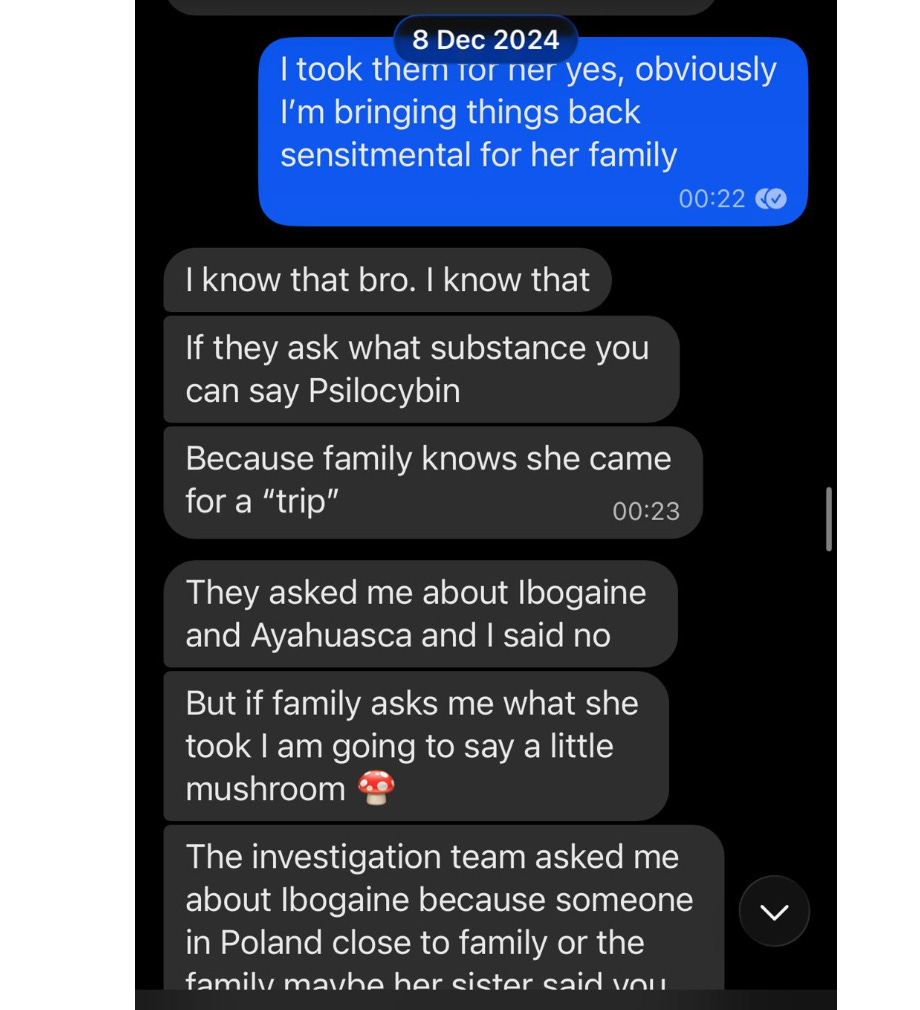
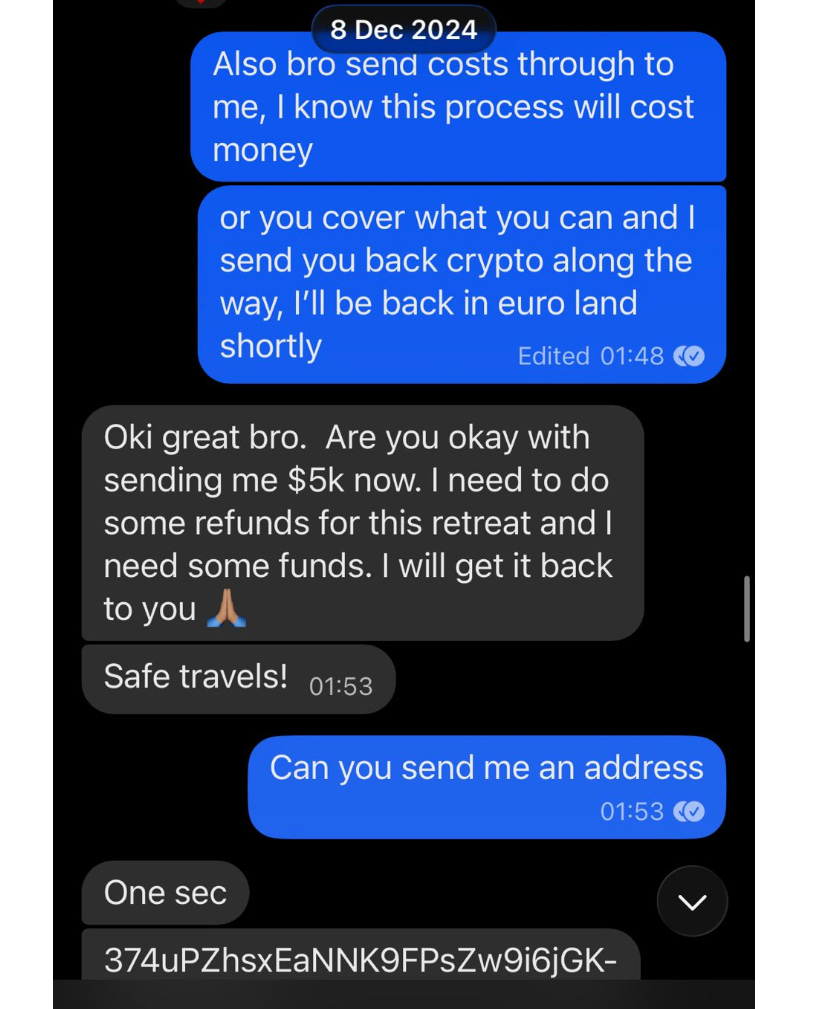
Another text message shows Esposito asking Stephen to lend him $5000 to pay refunds, after which he told Stephen the address where her body could be located.
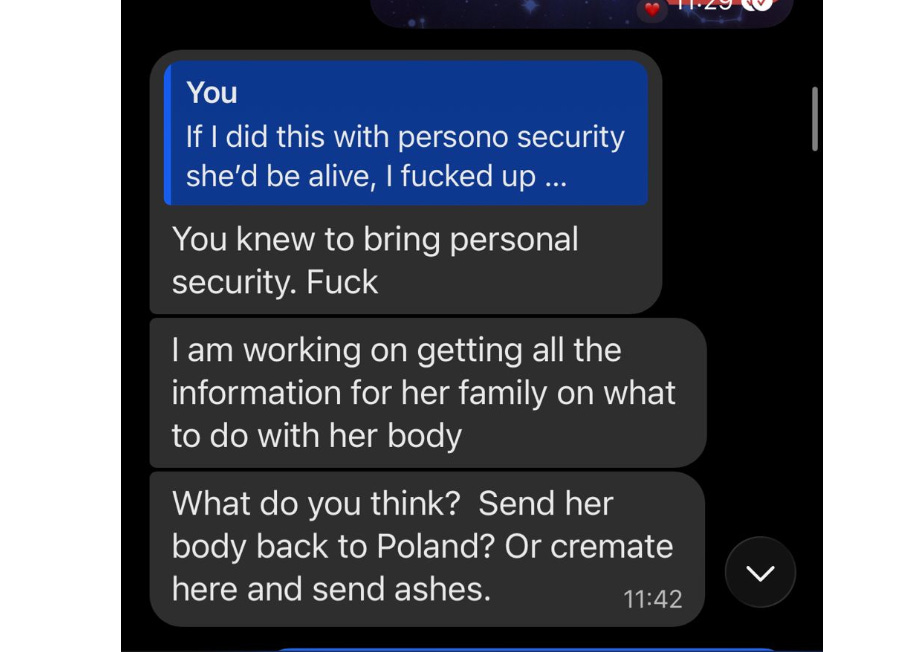
Stephen is furious that Blanka was allowed to leave the retreat centre, that her body was not found for so many hours, that he and Supatra were not woken up, and that Anthony was not (in his view) honest or supportive in the days after her death. Esposito seems to acknowledge in one text that there was not enough staff at the retreat to prevent guests from wandering into the jungle while in an altered state.
Stephen says he did not know that iboga is illegal in Costa Rica when he paid several thousand dollars for the retreat. Now, he has made an Instagram video denouncing Esposito, his company ‘Awaken Your Soul’, and Holos Centre, and is filing documentation with a Costa Rican lawyer to bring a case against Awaken Your Soul and Holos. Esposito declined to comment, while Ian-Michael Hebert, the owner of Holos, says Holos rented out the space to Awaken Your Soul and was not involved in the retreat.
The legal and safety situation is not good in Costa Rica, where the government allows psychedelic retreat centres to operate and charge clients tens of thousands of dollars, but fails to ensure the safe regulatory environment that high-end tourists might expect. Indeed, the toxicology report for Blanka failed to detect iboga in her system. Sexual assault is unfortunately common in the psychedelic market, and it’s rare for cases to go to court or lead to convictions. The owner of one of the biggest ayahuasca retreats in Costa Rica is being sued for rape by a former partner, and the General Prosecutor still hasn’t interviewed the plaintiff, years after she filed the charges.
But transparency could be improved in other jurisdictions as well. In January, according to reports we received, two sisters experienced a serious cardiac event while receiving treatment at a luxury ibogaine clinic in Mexico, and both required resuscitation. I asked the clinic for more information, but didn’t receive a reply.
After the paywall, the political push to legalize ibogaine in the US, and why it’s increasing scrutiny of the field and - hopefully - raising standards.
