

I’ve been following the Amy Griffin story for a while, and wrote two previous articles on it. In brief, Amy Griffin is a wealthy venture capitalist, a psychedelic philanthropist whose husband (a wealthy fund manager) gave a million bucks to MAPS. They’re also investors in Lykos / Resilient, the MDMA start-up founded by MAPS. Amy Griffin wrote a best-selling 2025 memoir called The Tell about how she did underground MDMA therapy and uncovered memories of being sexually abused by a schoolteacher for several years. It was a huge hit, and a major celebrity endorsement for the healing power of MDMA therapy.
Or was it?
There were some strange things about the book - first, the controversial topic of ‘recovered / repressed memories of childhood abuse’. Some people in psychology think they’re very rare and often unreliable, others are much more inclined to see them as reliable. The mainstream view is: go carefully, they might be reliable and true, but might not be, therefore therapists and guides should neither affirm nor deny clients’ memories.
This came up in a recent trial of psilocybin for anorexia by Compass, by the way. Two out of 18 participants in the trial ‘uncovered memories of abuse’. This was written up in a paper, and there’s since been a back-and-forth between researchers about whether these sorts of experiences should be uncritically reported as true memories or not.
In October 2025, the New York Times published a bombshell piece casting doubt on Griffin’s story. They pointed out some aspects of the story seem unlikely, there had been no other complaints against the teacher in 30 years, and they claimed that the teacher’s life had been destroyed by Griffin’s memoir, as he was easily identifiable to locals from details in Griffin’s book. No one working for Griffin ever contacted him to seek his response, and the NYT says the book wasn’t fact-checked by Penguin.
Next Saturday, come to the PsyEdu mini-conference online, featuring Tali Avron, Grace Blest-Hopley, David Nutt, Duncan Still, and me - tickets here. And on Wednesday 18th, come to our free online event on (ex) Mormons and psychedelics, featuring four great speakers. Tickets here.
In addition, a classmate of Griffin’s told the Times that various details of Griffin’s story actually happened to her! Here’s the passage in question from the October NYT article:
Aside from Ms. Griffin and Mr. Mason [the teacher], “Claudia” — a pseudonym for a middle- school classmate — is one of the most important characters in “The Tell.”
Throughout the book, Ms. Griffin describes harboring a suspicion that Claudia, too, had been victimized as a child by Mr. Mason, mostly because she long remembered seeing them together in a school hallway, with the teacher’s hand on Claudia’s shoulder.
In “The Tell,” Ms. Griffin recalls lending Claudia a dress for Cotillion, a dance unaffiliated with the school. This emerges as a central anecdote in the book. “The joy I felt to be able to offer Claudia that dress was boundless,” she writes.
She also writes that “in my memory, the dress and Claudia and Mr. Mason were all linked in some mysterious way I couldn’t explain.” After Ms. Griffin’s MDMA experience, she writes, she felt an urgency to reconnect with Claudia. According to the book, they met at a coffee shop. “I was abused by Mr. Mason beginning in the seventh grade,” she says she told Claudia. Ms. Griffin then asks if Mr. Mason had abused her too. Claudia says no.
But at the end of the book, Griffin receives a post-card from ‘Claudia’ which seems to confirm her story.
The Times interviewed many of Griffin’s classmates, and found one who said she had experienced sexual abuse by a teacher - but not the same teacher. Many of this classmate’s memories seemed to resemble aspects of The Tell.
When contacted by a reporter, the woman wrote back that she remembered Ms. Griffin but was “unfamiliar with the book.” After she was mailed a copy of the memoir and read it, she said she was deeply unnerved. Some of the descriptions in “The Tell” of Ms. Griffin’s being assaulted are eerily similar to the abuse she herself endured, she said. She has since retained a lawyer. The classmate told The Times that she had reconnected once in person with Ms. Griffin in recent years, and Ms. Griffin’s lawyer said she disputed this.
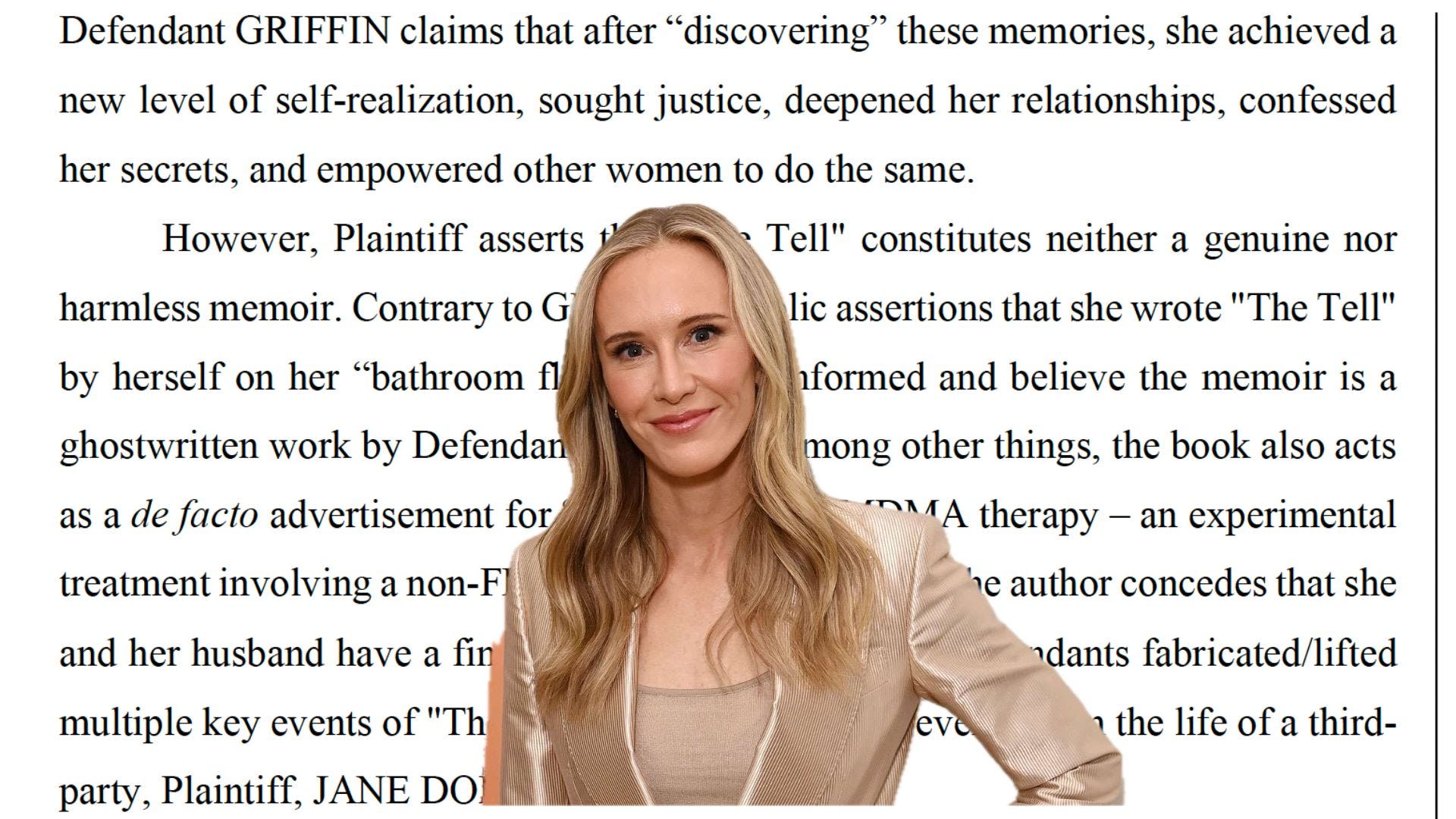
Now, the Times has a new story reporting that the classmate is suing Amy Griffin, and her ghost-writer Sam Lansky, and her publishers, for ‘invasion of privacy, negligence, and infliction of emotional distress’. This is the damning part of the NYT article, if it’s true:
In the lawsuit, Ms. Doe claims that she met with Ms. Griffin in 2019, at the author’s invitation, at a coffee shop in California and discussed growing up in Amarillo [Griffin’s lawyer denies this]. The suit also says that in 2022, Ms. Doe was contacted by someone claiming to be a talent agent and producer who “expressed an interest in using her ‘life story’” for a film or television show. During several subsequent conversations, Ms. Doe revealed her middle school sexual abuse. When Ms. Doe asked for a contract, the purported agent cut off contact, according to the lawsuit. Ms. Doe claims that the information she shared was then used in “The Tell.”
Griffin’s lawyer told the Times they deny the charges and are going to court to dispute them. The publishers and Lansky didn’t respond to the Times’ questions.
I found this so intriguing that I dug up the lawsuit and gave it a read.
More after the paywall, plus some other fascinating stories including the million-pound shaman scam, and how the British landed gentry are using energy healers to heal their hand.
