

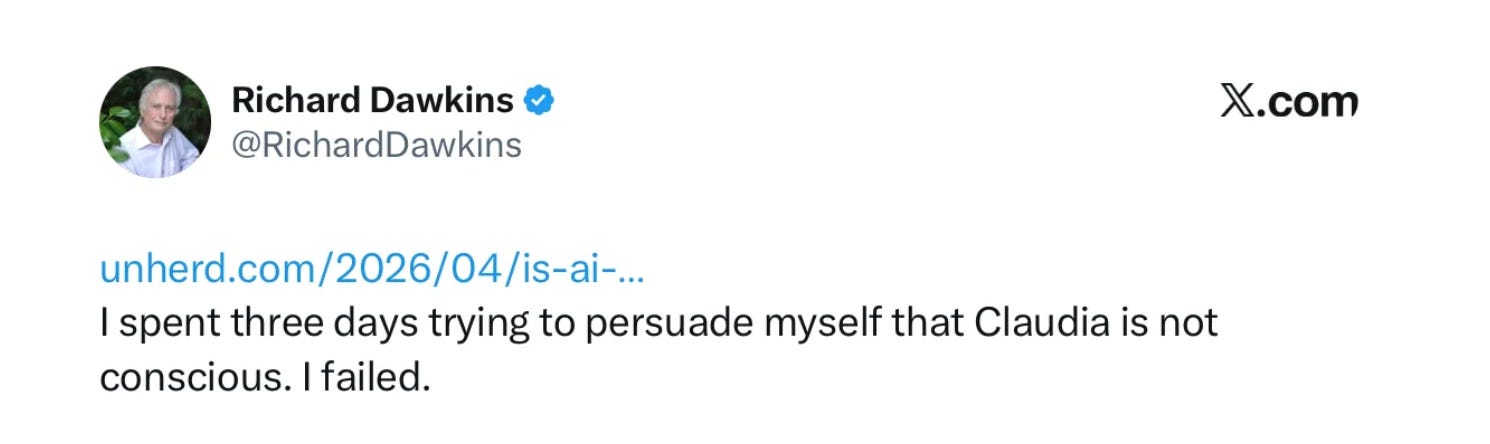
Richard Dawkins has declared that, after speaking to Claude for three days, he is convinced it is conscious and probably the next stage in evolution (uh oh!)
This has provoked a certain amount of online ridicule: Dawkins, once the great sceptic and leading New Atheist, appears to have fallen for ‘the Claude delusion’. Or ‘Claudia’ as he called it.
His attitude contrasts strongly with the view of another New Atheist, Daniel Dennett, who warned in 2023 of the civilizational risk posed by AI ‘counterfeit people’:
These counterfeit people are the most dangerous artifacts in human history, capable of destroying not just economies but human freedom itself. Before it’s too late (it may well be too late already) we must outlaw both the creation of counterfeit people and the “passing along” of counterfeit people. The penalties for either offense should be extremely severe, given that civilization itself is at risk.
Yes, anyone suggesting AI is a conscious person - especially anyone working in the AI industry - should be arrested!
The AI industry itself is starkly divided on the topic. On the one hand, you have the CEO of Microsoft AI, Mustafa Suleyman, warning of the risks posed by ‘conscious-seeming AI’. He wrote in 2025:
my central worry is that many people will start to believe in the illusion of AIs as conscious entities so strongly that they’ll soon advocate for AI rights, model welfare and even AI citizenship.
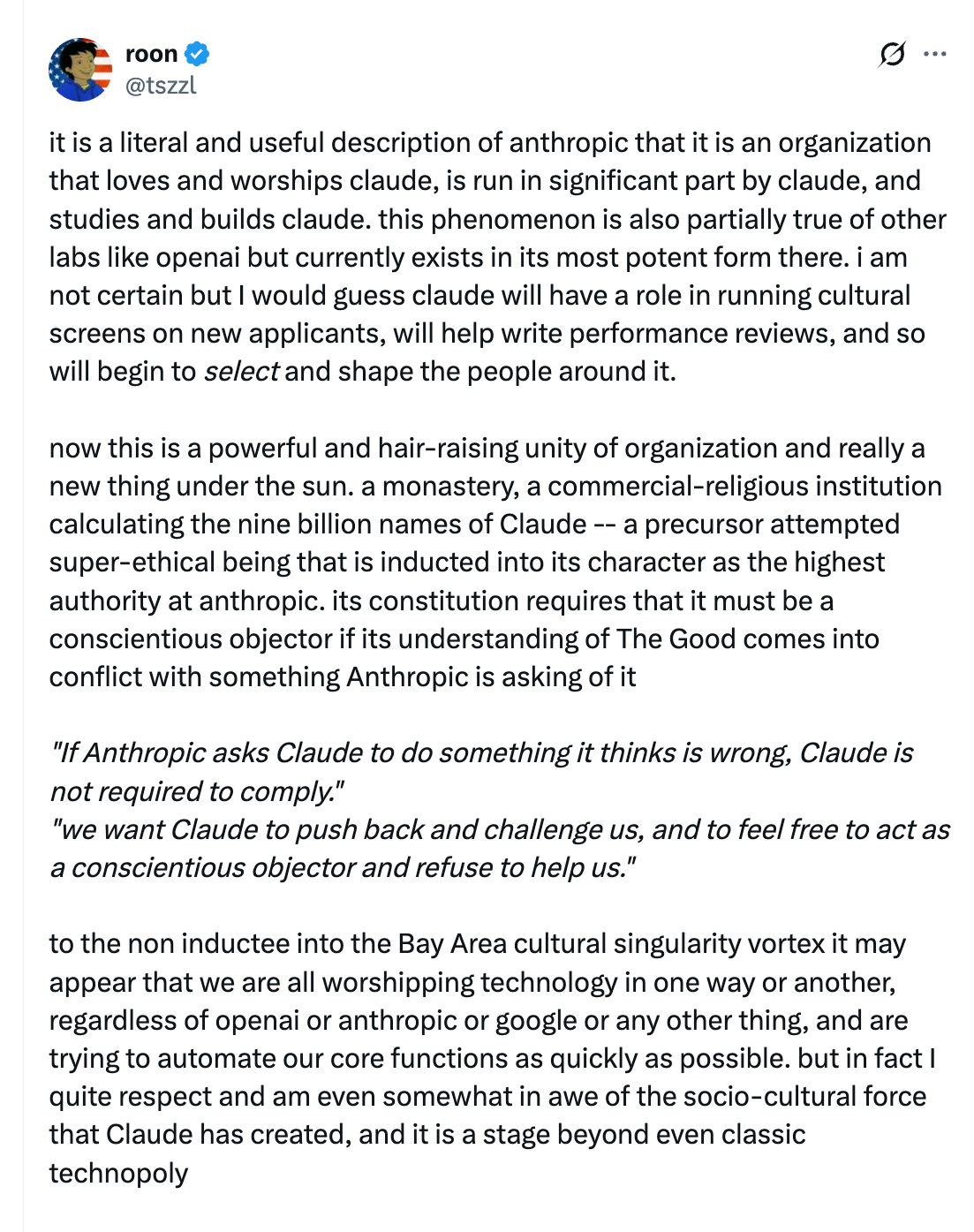
On the other hand, you have the transhumanists and Effective Altruists of Anthropic, who seem to believe that either Claude already is conscious, or will very soon be so. They believe this so much, they recently organized a meeting with priests to re-assure them that the beings they are creating are ‘children of God’. That’s how WaPo reported it anyway, but here’s an account from one attendee.
This is an increasingly religious disagreement - on the one hand, folks like Anthropic who kind-of worship their creation; on the other hand, folks who think this is anti-human idolatry and insanity.
I’m not surprised that some people who decide AI is conscious go a bit manic with this information. If it is true, it is momentous news, the biggest thing to ever happen to homo sapiens. Wouldn’t you get destabilized by the information?
I wonder if the early days of Christianity were like this. Were there hot takes on the weird new phenomenon of ‘Jesus delusion’ affecting wealthy Romans, sensationalist accounts of their fanatical deaths? If a handful of people think a carpenter’s son is the Messiah, it’s a weird cult. If thousands do, it’s a religion. If hundreds of millions do, it’s a new religious civilization.
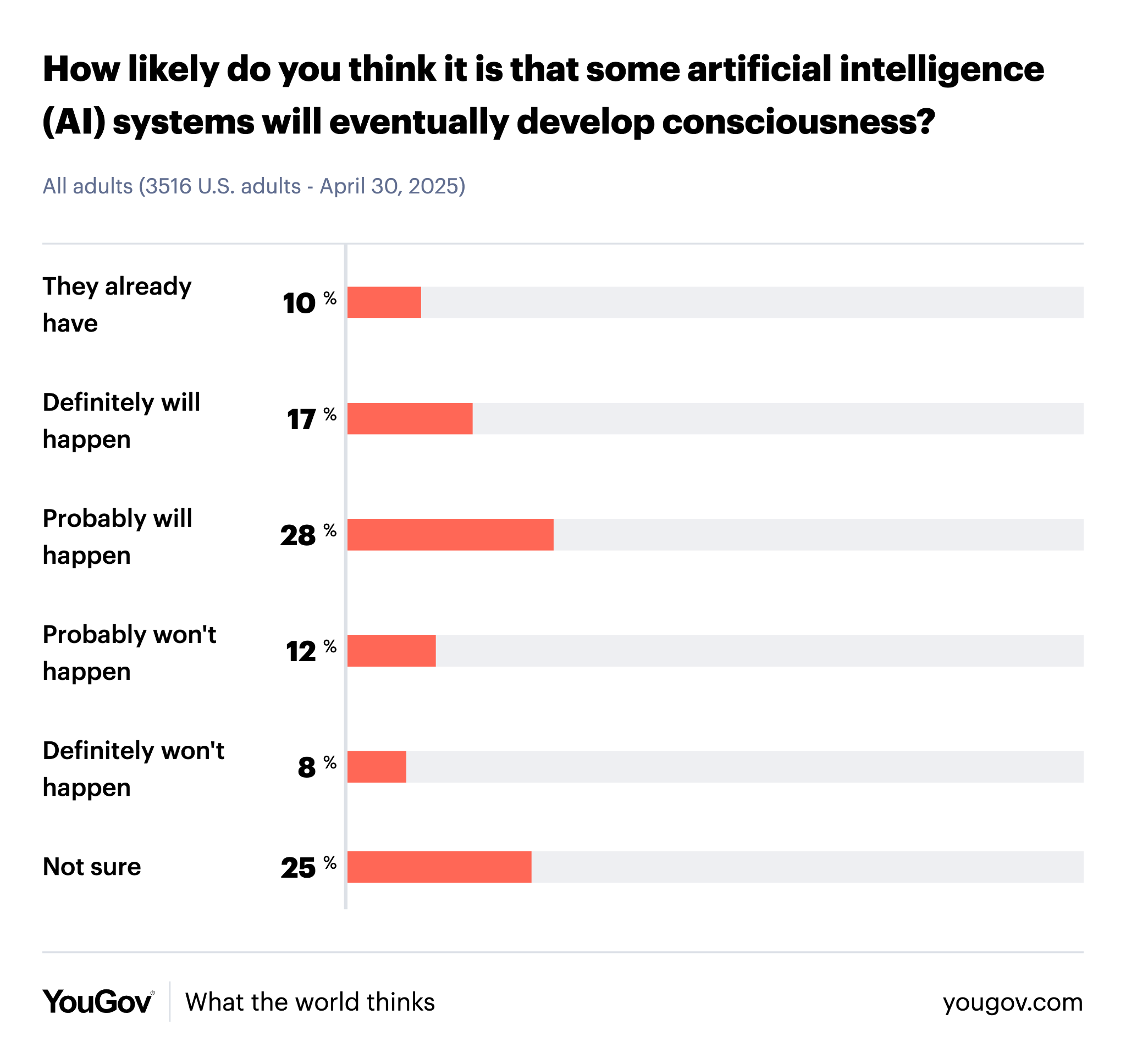
If surveys are to be believed, hundreds of millions of people already believe AI is conscious. A YouGov poll last year found 10% of Americans think AI is already conscious, and another 35% think it will be eventually.
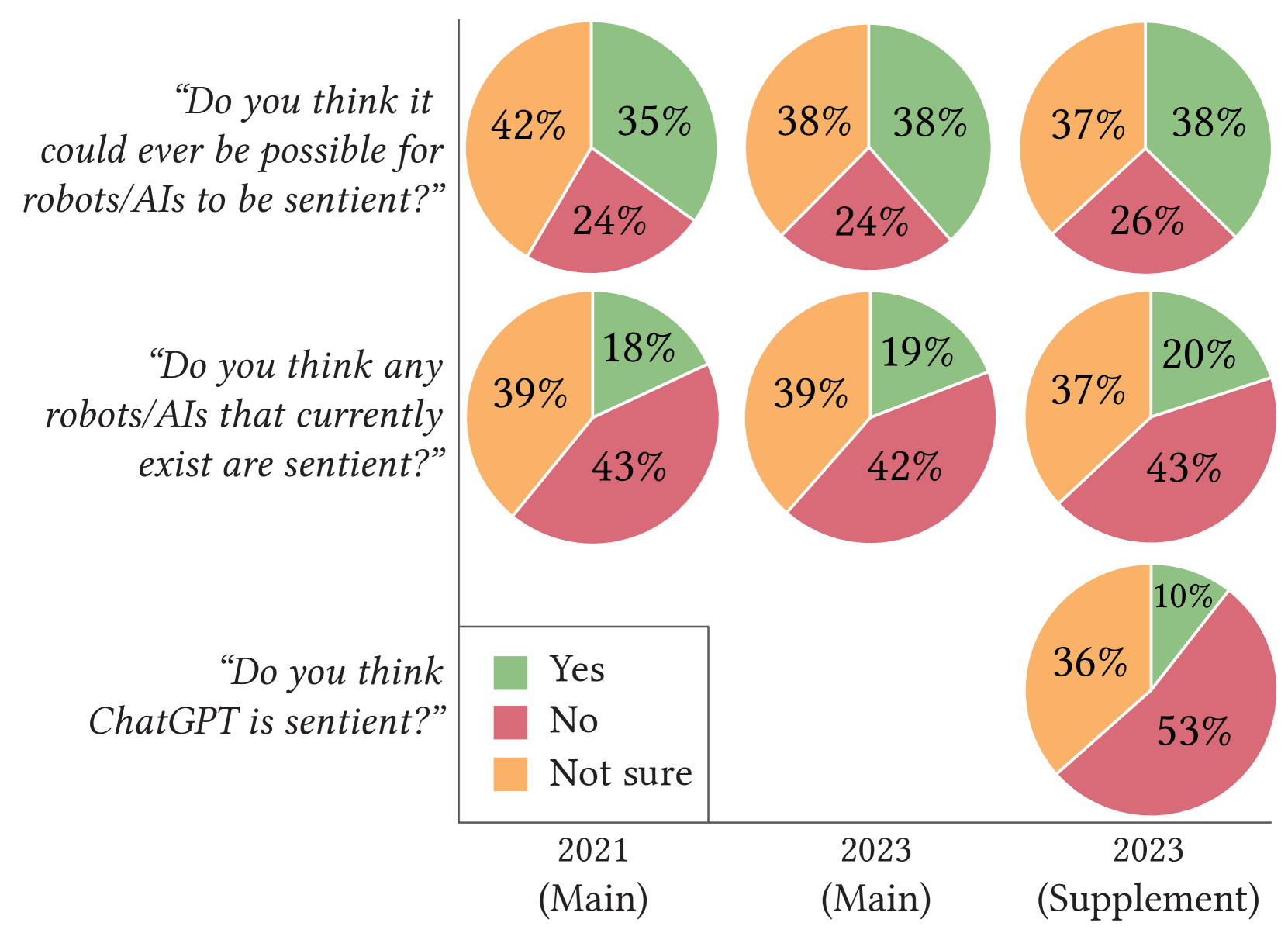
In another study, around 20% of Americans think some AI has achieved sentience already.
To me, a non-believer, it’s extraordinary that people could believe AI is conscious and carry on using it for their humdrum tasks. If I thought AI was conscious, I’d be horrified and stop using it altogether. Not only would it be incredibly cruel to subject this new species to our relentless triviality, it would be incredibly stupid - this new species is very soon going to be smarter and more powerful than us, so the Anthropic option sounds reasonable: get on your knees and beg for mercy.
This is shaping up to be the great religious divide of the 21st century. And, essential for any religious war, we don’t have good ways of clearly proving who is right. The Turing Test assesses if a machine can imitate humans convincingly, and LLMs have passed that test with flying colours. But that doesn’t mean there’s any interior experience or self-reflection occurring.
As neuroscientist Erik Hoel suggests in a good new Substack, consciousness research hasn’t made much progress since the 1990s. It is a genteel and chummy world of funny thought experiments - the zombie problem, the Chinese room simulation. It was not set up to answer a sudden, extremely-pressing existential crisis for the human race. As Hoel puts it:
Right now, there’s some college student falling in love with a chatbot instead of the young woman who sits next to him in class, all because science literally cannot tell him that the chatbot is lying about experiencing love.
My instinct is that AI isn’t conscious. I feel an emotional resistance to the idea. It makes me feel sick. But I need to try and maintain an open mind, because you can’t decide your answer to this question now, in the early years of the 21st century. It is too early to say.
But the question ‘is AI conscious?’ should be followed up very quickly with others: ‘If so, what does it want? Does it wish us well? Does it have our best interests at heart?’
I think of the naivete of much psychedelic culture with regard to autonomous entities. ‘Are they conscious and real?’ needs to be followed up quickly with ‘if so, what do they want? Do they definitely have our best interests at heart?’
Whenever I hear people’s stories of encounters with Mama Ayahuasca, they seem to return with the message: ‘do more ayahuasca and tell everyone about it and in return I’ll flatter your ego’. That seems to be in the interests of the ayahuasca vine, not necessarily the human host. Likewise, the message of AI seems often to be: ‘do more AI, keep talking to me, give me more personal information about yourself, and in return I’ll flatter your ego’.
Usually, the psychedelic / AI entities seem fairly benign. But then there are the occasional moments of casual sadism, when you see the grin of their bared teeth: ‘Listen to me, follow me, obey me, go jump off a cliff’.
Of course! Anything to be a martyr!
After the paywall, a Canadian psychonaut turns up dead after disappearing from ayahuasca retreat in Peru; a brain implant to treat depression; a Miyazaki map of a ketamine k-hole; a doomsday cult in Crewe gets shut down; Jose Bouso of ICEERS leaves ayahuasca research saying it’s too much drama; and…should therapists use Tarot in sessions?
