

Warning for content about suicide. Also not recommended to read if you’re planning to take psychedelics in the next week.
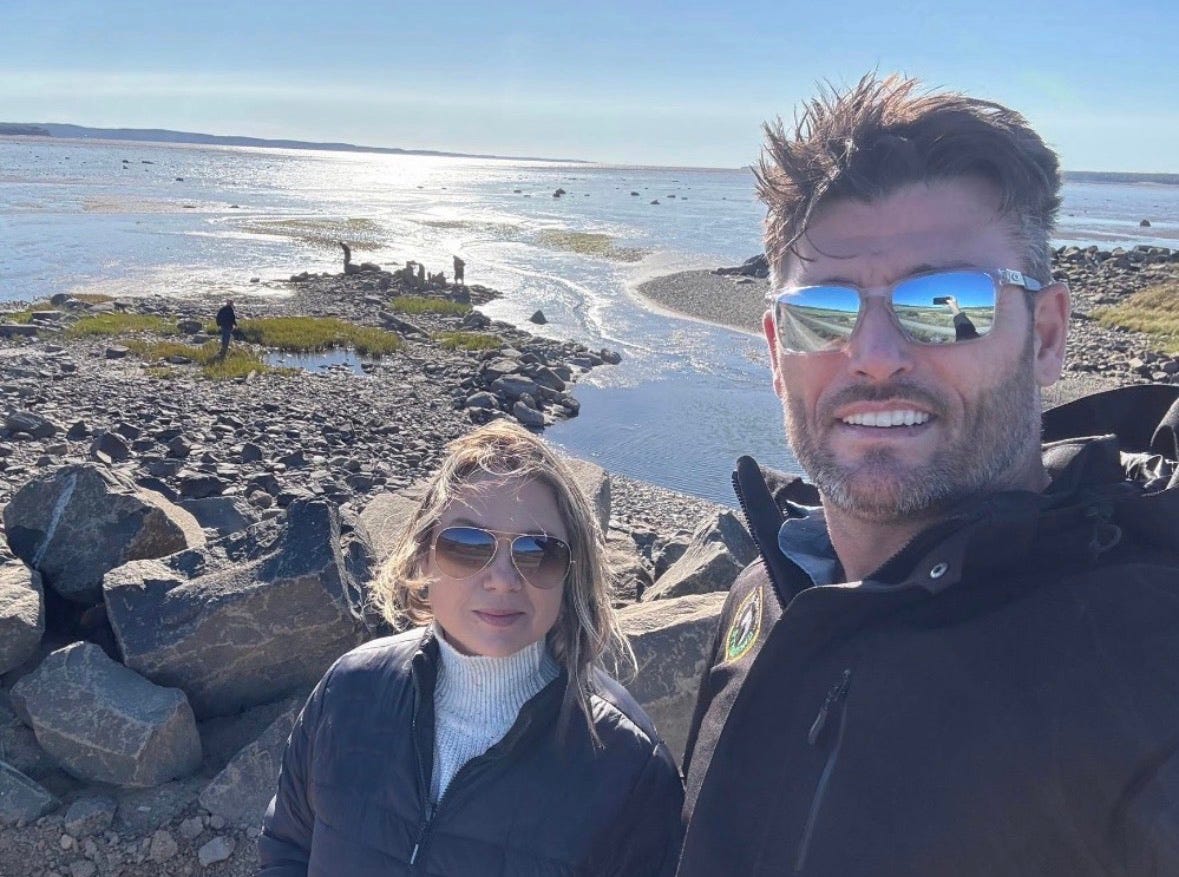
Kelly met Chance when she was 17, on a fairground ride called the Gravitron: ‘he was the boy in the middle of the ride running it.’ They lived together as teenagers, drifted apart, and reconnected on social media 24 years later. He moved into her Montreal home in April 2024, they were engaged within three months, and in September 2025 they moved with two of their children to a 108-acre property in rural Nova Scotia. Kelly tells me: ‘We used to always say to each other we owed each other 24 years, the years we had lost.’
Chance, 45, was 6’5, ‘a massive man with a bigger personality’. He had struggled with cocaine and opioid addiction in the past, after the death of one of his sons ‘sent him down a bad path for a while’. But he was rebuilding: a new job as an electrical estimator, a house to renovate, a wedding planned for September. ‘He would always tell me, ‘Thank you for loving me. Thank you for choosing me. Thank you for giving me this life.’’
He took mushrooms occasionally, about six times in their three years together. ‘It was the alternative to the stuff he thought wasn’t safe’, Kelly says. She had never taken them. When she looked them up, ‘all I saw was all these things that it can treat. It never said it could hurt somebody.’ She says he had no history of suicidal thoughts and was outspokenly ‘anti self-harm.
Three minutes in May
May 2nd 2026 started like any other day. The family spent the day building a fire pit. A friend of Chance’s was due to stay, and he and Chance planned to take mushrooms together, so at about 4:30pm Chance ordered mushrooms from a nearby online dispensary, and they were delivered to the house around 6pm. The friend didn’t come, but Chance took them anyway at 8:30pm, by the fire with Kelly, his 19-year-old son and her brother. He took 14 grams, which Kelly says was his usual amount but which for most people would be a very high dose (an average dose might be three grams). For two hours everything was normal.
At about 10:30pm he said calmly: ‘I’m never taking mushrooms again. I don’t like how I’m feeling. I’m going to bed.’ Kelly wasn’t alarmed. ‘What I didn’t know is those would be the last words he would ever say to me.’
He went upstairs. She went out to douse the fire and briefly left him alone. ‘I’ve walked it. I’ve timed it, and the most it was was three minutes.’ When she came back in, she heard a strange noise from upstairs. He had collapsed at the top of the stairs with self-inflicted knife wounds. She did CPR for 13 minutes. “He stared into my eyes. And I watched him die.”
There had been no visible crisis. ‘There were no big signs. There was no big freakout. Sometimes there’s no big event. It’s silent.’
The family was questioned repeatedly by the Royal Canadian Mounted Police. They didn’t even ask about psychedelics. For two days Kelly was ‘absolutely catatonic.’ Some of Chance’s relatives could not accept that he would do this and suspected there was ‘more to this story,’ which has split the two families. Then Kelly began to search online for similar cases. ‘When you change the words on Google, you change what you find.’ She found other cases like Chance’s, in which people seriously or fatally harmed themselves during psychedelic experiences.
At first Kelly told people Chance had died of a heart attack. ‘I was ashamed.’ Then she decided: “How many tragedies have to happen before somebody stands up? And then I thought, it’s going to be me.’ With a career in public relations, Kelly has launched a campaign to improve public understanding of psychedelic risks. She founded an organization called Don’t Take Chances (donttakechances.ca) and published a book, Three Minutes. ‘I always said it took three minutes to take a life. Maybe it can take three minutes to save one.’ She says she is not anti-psychedelic, she is pro-informed consent. ‘People cannot make truly informed decisions about risk if they do not know that the risk exists.’
How do you define fatal self-harm during psychedelic intoxication?
The final autopsy report for Chance’s death, completed on 29 September, confirms multiple sharp-force injuries, most of them superficial, and a fatal stab wound to the chest. The manner of death is given as suicide. Kelly rejects this ruling: ‘To be suicidal, you have to have intent. Chance was not a man that wanted to die.’
The report openly acknowledges the difficulty. It cites a 2026 paper (which I shared with Kelly) about an incident of fatal self-harm under psilocybin, where the pathologist favoured suicide but the coroner ruled the death undetermined, and it notes the question of whether the drug itself can precipitate self-harm. It then falls back on the 2002 US National Association of Medical Examiners guidelines, which suggest that self-inflicted deaths under a voluntarily-taken mind-altering drug be classed as suicide, because the person ‘assumes the risk’ of the drug’s effects on their behaviour. It adds that self-inflicted sharp-force injuries carry ‘a self-evident intent to harm,’ and that it is essentially impossible to establish that the act would not have happened without the drug. The case went to the service’s Difficult Case Rounds, where multiple medical examiners agreed.
Kelly tells me the assumed-risk reasoning is ‘the part I am struggling with most…Chance and I did not know this was a risk. How can the fact that Chance voluntarily took mushrooms demonstrate suicidal intent on the basis that he assumed the behavioural risks of taking them, when he did not know that this was one of those risks?’ She will ask the medical examiner what evidence established suicidal intent, as distinct from ‘a catastrophic drug-induced behavioural reaction resulting in fatal self-injury.’ She says: ‘That’s a fight I’m going to have for his children, for his grandchildren, for his great-grandchildren.’
Ironically, if you kill someone else while high on psychedelics in Canada, you can plea ‘automatism’, ie loss of control through intoxication, and may be convicted solely of manslaughter rather than murder, as in the case of Thomas Chan, a young man who killed his father on mushrooms and who successfully pleaded manslaughter through the automatism plea. In psychedelic murder cases, then, defendants can sometimes plead no intent and temporary loss of control for their actions during trips. In incidents of psychedelic fatal self-harm, by contrast, the medical presumption is that the death was intended.
How Chance’s death matters not just for Kelly, but perhaps for how the police treat the supplier. Several months after the tragedy, the company Chance used to order magic mushrooms is still operational - the Mounties told Kelly there is no criminal investigation into them, because Chance’s death was ruled as suicide. I’m not sharing the name of the online dispensary because Kelly is worried they could pose a risk to her and her family. There’s still no health warnings on any of their products. Kelly says: ‘Cigarettes have health warnings on them, why shouldn’t mushrooms?’
The non-zero risk of fatal self-harm during trips
Deaths during psychedelic experiences are thankfully very rare, and population-level studies show no strong association between psychedelic use and suicidal ideation or behaviour (Johansen & Krebs, 2015). However, one large survey found that 6.7% of psychedelic users thought of harming themselves or others during a psychedelic experience (Simonssen et al 2023).
One study (Darke et al 2024) found 43 psychedelic-related deaths reported in Australia between 2000 and 2023. A third were classified as fatal accidents, and typically involved people falling or jumping from buildings or bridges. A third were classified as ‘fatal self-harm’ (ie suicide) and typically involved people stabbing themselves. The rest were classified as drug or multi-drug toxicity, or undetermined.
So it seems if people take psychedelics then fall from a height and then die, as Nick Cave’s son did, or even if they jump from a window or balcony, it’s likely to be classified as an accidental fall, while if they take psychedelics and then stab, shoot or hang themselves, it’s likely to be classified as intentional self-harm / suicide. Yet in both cases, there is usually no pre-trip intent to die.
Behind the statistics are tragic stories of families forever impacted. My friend Kristin Nash lost her son William to a psychedelic-related accident when he was in college. Her colleague in the Coalition for Psychedelic Safety and Education, Susan Sagy, lost her daughter to another tragedy of psychedelic-related self-harm. Both their children were 21 when they died. Earlier this year I interviewed Rebecca, who lost her 20-year-old son Ariel when he shot himself during a mushroom trip. None of these young people had pre-existing suicidal intent.
How law enforcement treats the supplier or facilitator in such cases
After the paywall, why do the police sometimes go after the suppliers in psychedelic-related fatal accidents, and sometimes not?
