

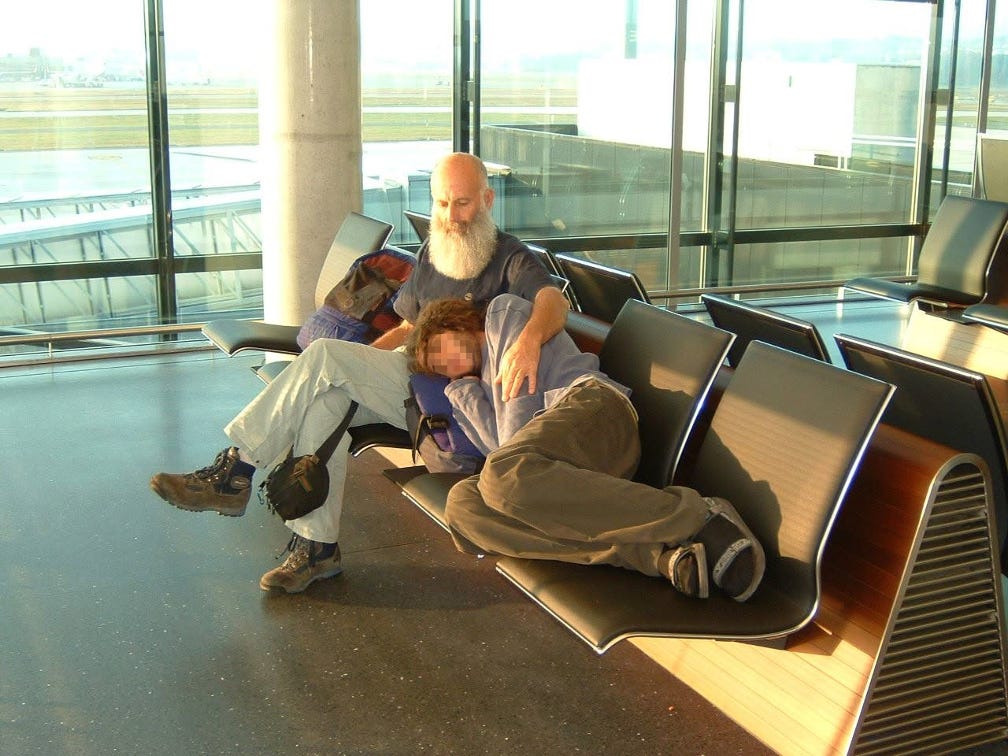
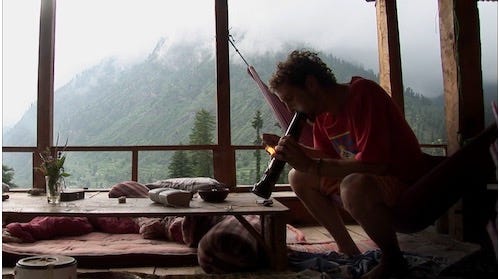
Hilik Magnus is the 77-year-old founder of Magnus Safety, a unique search-and-rescue service for Israelis and other nationalities who find themselves in crises while travelling. His typical client is the family of someone who has lost their mind on drugs while travelling. His organization was founded in 1994, and he says in the first decade, most of the rescues involved young Israelis travelling and smoking a lot of cannabis after military service, although he says these days rescues are often of people in their 30s. He has developed a protocol to track and bring home people in four days, even if they are in psychotic states. His work is famous in Israel, where travelers sometimes wear t-shirts saying ‘You won’t catch me, Hilik’. He featured in a 2008 documentary called Flipping Out, about young Israelis losing it in India after leaving military service. It suggested a high number of Israelis ‘flip out’ when travelling after military service, partly from PTSD. Readers will have a range of views on the Israel Palestine conflict, through which they will view this interview - I was specifically interested in the protocol he has developed to work with people in drug-induced crises. This interview was done the day after the Nepal tsunami.
Jules: You are in Nepal at the moment?
Hilik: I am not, but I have two teams working there now.
What’s the situation there?
The situation is that a lot of people die, much more than they are providing numbers. The numbers will rise.
How come your team is there already? The tsunami only happened yesterday.
I have a network of teams all around the world, more than 2000 people.
How did you how did you get into this work, and when?
A friend came to me in 1994 and told me, listen, let’s provide search-and-rescue for Israeli travelers. So I thought to myself, oh nice, we will be forever on a trek. And I started to build it.
Had you recently left Mossad?
This is not important.
But you were in the military?
Of course, everybody in Israel does military service. I had been also the chief of the nature reserve in Sinai until we withdrew from Sinai.
The first case you had – it was a young woman in India?
Yeah. I remember. She was 20 years old. She had taken a lot of drugs, including some magic mushrooms. She was severely harmed, in a coma, in a catatonic position on the beach. Some travelers called the family. The family sent her uncle. Her uncle came and took her with him but couldn’t control her. So at the airport she undressed herself, starting running around the airport naked, shouting “fuck me, fuck me’. The uncle tried to calm her down, but couldn’t do it, and he left for Israel, crying. The Hindu taxi driver, who was a very good person, took her, dressed her, and drove her back to the same beach in Karnataka, and the boy who informed her family suddenly saw her again, and he called the mother, and she came to us.
So we flew immediately the same night to Delhi, then from Delhi to Mumbai. Then driving a jeep all night to Karnataka on an unpaved street without asphalt. We came to the beach at 5 in the morning. Everybody was asleep. We looked for the boy. We found the boy in one of those shelters. We waked him and asked, “Where is she?’ He took us. He told me, “I’ve seen her yesterday on the beach sleeping’. So we went down to the beach. She was curled up like a baby. We waited. She stood up, shouting crazy. She was dirty. She was extremely wounded. So we undressed her. We took a bucket and cleaned her with water out of the sea because there was no running water there. I took out a couple a pair of trousers and t-shirt for my backpack, and dressed her, and I carried her on my back up to the road, which was a hard climb. And we took her to the airport. We took good took good care of her. We flew with her to Mumbai, took her to a five-star hotel, and the wife of the consul cleaned her and dressed her in decent clothes. We tried to make her eat. She ate slowly, and it took another two days until we could fly her back to Israel. When I flew her over, I came to the airport. She, of course, couldn’t answer any questions. She was not able to communicate. And suddenly, I am approached by some person at the airport who asked me what I’m doing. I told him, listen, she is harmed, I am trying to bring her home to rehabilitate her. He told me, come with me. It was the manager of the flight company, and he located us in the business zone in the airport, so we can take good care about her. And we flew her home. But she was in very difficult situation, and we had to come several times to take her back home because she ran away, to calm her down and so on. We did it, of course. Today she is a mother and lawyer and nobody could even notice that something was wrong anytime.
So after that first case, you established a regular service for these sorts of mental health crises among travelling Israelis?
Yes, we were providing search and rescue for travelers. We spent time with the youngsters at the guest houses where they used to stay. We were the adults who were approached: ‘Hey, listen! This guy lost his mind. That lady is running naked in the street. He’s destroying all the guest house’ and so on. We no knowledge of this culture at the start. I never have seen drugs, and suddenly I found myself in a situation where I have to respond to the calls of the youngsters, and I came in touch with those disturbed youngsters, and I looked at them and tried to understand what’s going on. And slowly, I found out that I can understand the language. It is a language of behavior, and I provided a solution for this. I built a protocol which gave me the possibility to reach those people and to bring them in no time to cooperate with me. Here’s someone destroying all the guest house, frightening everybody. And here I am hugging him, and I am walking with him through the immigration in the airport, and I am flying with him safely home. And in those years, flying home means almost five days of traveling. And I spend time with him 24 hours a day.
Wow, bringing someone back from South America or from Australasia, those are long flights, and these people may still be in some kind of psychotic state.
Sometimes they don’t sleep three or four days. So you cannot sleep. You have to be with them. I’m with them 24 hours a day. So we are going in two person teams. If I’m tired, I tell my partner, “Hey, take over’. And I’m falling asleep for half an hour or an hour. You understand?
Can you ever offer them like benzos, tranquilizers?
No, we don’t need it. Normally, we don’t need it. But sometimes we are coming to a person that is in a mental situation for a month or two. So we got a doctor. He will provide some medication.
And I guess sometimes they might be in trouble with the local police.
Sometimes I have to release them from prison. And then I have to help the families handle the stigma. Because the families are also casualties of drugs [through association] and can feel guilty. His father is a decent man, and now he is in a in a deep shitty story of drugs and jail. Why? Because of the hypocrite behavior of the countries. You go to a country where drugs are common, like eating a sandwich, and suddenly they caught you with drugs and they put you in jail, and they show all the world how they are fighting drugs. It’s total bullshit.
So I developed a protocol how to behave to people like this. I taught it to the members of the team, and they did it the same as me. And the situation was tough because the youngsters those days didn’t use drugs in Israel - the first time they used drugs was travelling, so many of them got harmed. I was flying at least three times every month. There were weeks in which I flew twice a week.
Always to India?
Not always to India, also flying to South America, flying to to Australia, flying to New Zealand, flying anywhere.
Were drugs always involved?
Most of the occasions, drugs were the catalyzers for people losing their minds.
As in psychosis? Manic episodes?
I call it a mental fracture. If you got a fracture in your leg, everybody knows what to do. They have to tie your leg and to bring you to the hospital to provide the X-ray and then to put the bones together to put around the bandage, and after three, four weeks to give you some physiotherapy, and then after half a year you are walking, running, and dancing.
It’s the same with the mental issue. you handle it correctly, it is not anything more like a fracture. If you know how to handle it, it will end in a good situation. Very quickly, I understood that the person who got harmed needs the family to rehabilitate them. If you don’t support the family, if you don’t address them and give them the tools to handle the situation, the boy or the girl that are harmed will never recover.
So you have to give the family advice?
Yes. I developed a huge protocol how to do this. And today we are we are bringing in all the family. We are advising them and teaching them how to behave, how to understand the situation. We are handling them through the telephone after we return their loved ones, and we escort them until they reach the light in the end of this tunnel.
So the context is that young Israelis leave military service and often go traveling afterwards, and often take a lot of drugs.
This is not correct today. This story is a part of anti-Israeli political issue. I checked the statistics in Austria, in Germany, in France, in Italy and in Japan. And what I found out is amazing. They have more drugs casualties than we do in Israel.
I’m just talking about your kind of typical client. There will often be a young person who’s traveling after the military?
No. That was in the first 10 years. But today, all the people are consuming drugs, especially cannabis. So they are not using drugs for the first time when travelling. What I see is a change in the casualties’ age. We got more casualties in their 30s than in the 20s.
Are all your clients from Israel?
Not all of them.
And what kind of drugs are typically causing the problems?
80% of the casualties are of cannabis, not because cannabis is the most dangerous drug, but because people consume more of it than other drugs.
And people are smoking it every day.
Every day, all the day.
What about psychedelic drugs like ayahuasca?
Such drugs are dangerous, but not many are using it. If they are using it once in a party, it is not a problem. But people who use it more often, they are exposed to a danger.
So you know the famous T-shirt that said, ‘Hilik won’t catch me’. Do people ever not want to come back to Israel?
No, it never happened to us that somebody didn’t want to come back. We are not forcing them. We are not injecting them or forcing them to take medication. We are handling them by the protocol that I develop, and they participate and are willing to come home, and they are getting listened to for rehabilitation. We have to convince people, bring them to a decision that they are going to make the effort and rehabilitate. You cannot force somebody to follow a program like that.
Do you ever track people down, and they are in a spiritual community or in a cult?
Yeah. It happened several times, and it is a little bit more difficult to convince them to leave and to follow you. The situation is complicated. It takes more time.
How long does the process usually take, when you are hired by a family to track someone down?
The process takes 4-5 days.
You can you can find people and bring them home in four or five days?
Yeah, it is easy.
Anywhere in the world.
Anywhere in the world. We are doing it very quick. Meanwhile, we are preparing the family to face the crisis and to handle the situation. You and me are normal people. We share the same circle of logic and experience. If you meet someone in a crisis, they are not logical, not sane, and their experience and reality is different than yours. So those two circles are not joining each other; they are opposite each other. So you have to get the chords of the language in which he is operating.
What kind of language is that - quite spiritual, quite paranormal?
If you want me to give you the protocol, I will give you two sentences, and you will find out how to manage a person in a mental crisis.
First, you have to manage yourself, your thoughts and your feelings. Not to manage him, you have to manage yourself, because he is in a high-sensitive situation. He is not listening to what you are talking logically. He is reading your feelings and your thoughts, and he is not in self-control, he will amplify your feelings and your thoughts. So if you are nervous, he will be hysterical. If you are frightened, he will be angry, he will become violent. You have to be able to control yourself and to behave correctly. You are asking yourself always, how do I feel? If you feel that you are angry, cool yourself. If you are not able to cool yourself, let somebody different handle their case.
More after the paywall, including links to other interesting stories from around the internet.
