

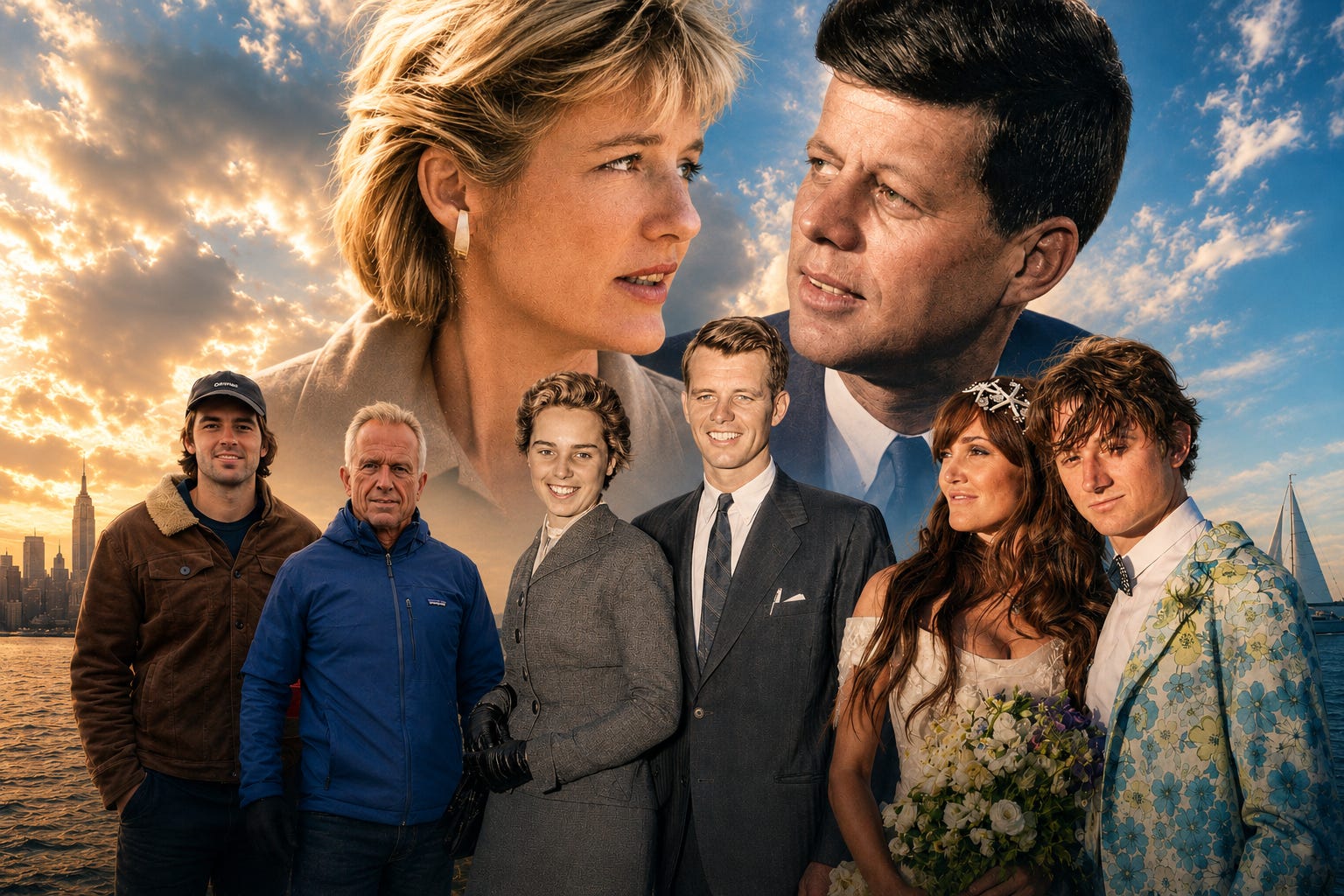
President Trump’s Executive Order on psychedelics on April 18 2026 was a remarkable moment in which the US federal government publicly embraced the healing potential of psychedelics. Robert F. Kennedy Junior, the Secretary of Health and Human Services, was standing behind Trump, and was arguably the key figure who made the EO happen. In one of those weird echoes of history, it occurred sixty years after his father held a Senate hearing to discuss the potential healing and harms of LSD. In fact, for three generations, America’s ‘royal family’ has been using and promoting psychedelic drugs, and shaping the nation’s relationship with these substances. The history of psychedelics in the US is intertwined with the history of this glamorous, flawed family whose lives so often seem to meet violent ends.
John F. Kennedy
The relationship of President John F. Kennedy to psychedelics is the most speculative and least evidenced in this tale, but we might as well start here, with the story of JFK’s affair with DC artist, socialite and would-be psychedelic guide, Mary Pinchot. In the early 1960s, Mary was having an intense love-affair with JFK, and spending a lot of time with him, including at the White House.
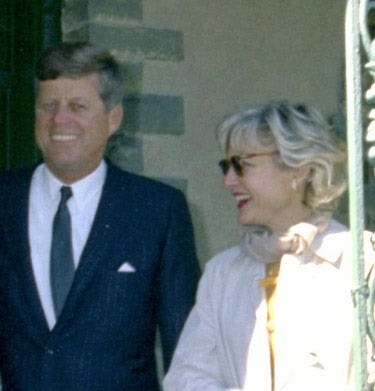
At the same time, she was also discovering psychedelic drugs. She visited Timothy Leary at Harvard and, according to Leary, wanted to set up a network of DC guides to turn on powerful men in the capital, possibly including the president. In his 1983 book Flashbacks, Leary claims Mary said to him:
I have this friend who’s a very important man. He’s impressed by what I’ve told him about my own LSD experiences and what other people have told him. Isn’t that the idea – to get powerful men to turn on?’
We don’t know for sure if Mary and JFK really did have any psychedelic sessions, but Leary claims Mary called him the day after the JFK assassination and said ‘he was changing too fast; they couldn’t control him anymore’. JFK was assassinated on November 22 1963, the same day Aldous Huxley took acid on his deathbed.
Mary’s ex-husband Cord Meyer was a senior figure in the CIA, and she apparently believed JFK had been murdered by the CIA in a conspiracy involving several of its highest-ranking figures, including her ex-husband. She was herself the victim of a professional assassination less than a year later, in Washington DC. The murder was never solved. If you want to go down that particular rabbit hole, read the book Mary’s Mosaic, by Peter Janney - Janney marshals the evidence suggesting Mary was the victim of a CIA assassination, to stop her from revealing details of the CIA’s role in JFK’s murder and other illegal operations. Janney presents convincing evidence that his own father, senior CIA agent Wister Janney, was involved in the operation, knew Mary Pinchot had been murdered before it was announced publicly, and lied about this to his own family. Peter Janney suggests various other establishment figures cooperated in the cover-up of Mary’s murder and her secrets, including her own brother-in-law, Washington Post editor Ben Bradlee, who reportedly helped to locate and destroy her diary. Janney finds another piece of evidence supporting the CIA assasination theory in an interview by Gregory Douglas with Robert Crowley, deputy director of CIA clandestine operations. Crowley supposedly told Douglas:
We terminated her, of course. Everyone felt she had too much influence with him, not to mention her hippifying him with LSD and marijuana…after Dallas, she began to brood and then started to talk. Of course she had no proof but when people like that start to run their mouths, there can be real trouble.
Ethel Kennedy
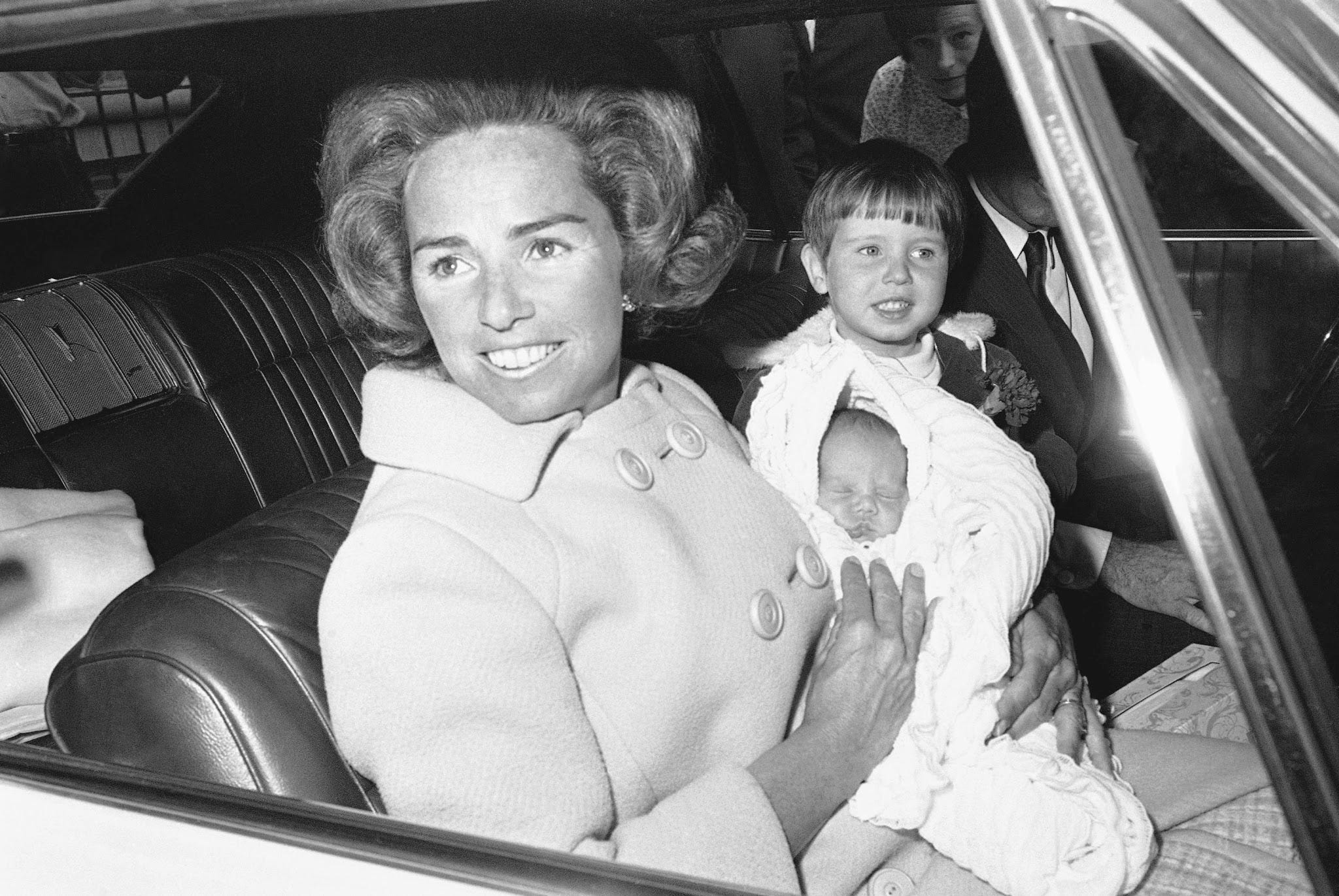
Ethel Kennedy was the wife of Senator Robert F. Kennedy and the mother of RFK Junior, and ten other children. She also became a prominent humanitarian activist.
According to some sources, Ethel received LSD therapy from Dr Ross MacLean at his psychedelic therapy clinic in Hollywood Hospital, in BC, Canada, in the 1960s. This was first suggested in Martin Lee and Bruce Schlain’s Acid Dreams (1985), then repeated in Michael Pollan’s How To Change Your Mind and other sources. I haven’t seen hard evidence for this, and don’t know when she was treated and why (if indeed she was).
Dr MacLean supervised around 6000 LSD trips for everything from alcoholism to anxiety and marital conflict, from 1957 to 1972. He worked with Al Hubbard, a millionaire with connections to the CIA who was an early adopter of psychedelics in the 1950s. At one time Hubbard had the largest stockpile of LSD in the United States. Hubbard believed in the same sort of psychedelic evangelizing as Mary Pinchot reportedly planned - spread the word by turning on the elite. The wife of a US senator would have been the perfect client.
If Ethel did receive treatment at the Hollywood Hospital, what would it have involved? This is from a PhD by Andrea Ens at the University of Saskatchewan:
The cost of this exclusive treatment was prohibitive..If potential patients decided to spend five days at the hospital for their first treatment session, they would be billed $544.00 CAD, or $3,855.30 CAD (2017) when accounting for inflation…Psychedelic therapies typically began between 8:50-10:00am... Patients were dressed comfortably for their treatments, often in pajamas and a bathrobe, to create a relaxed physical and emotional environment during therapy.
The specific dosages varied. On average, patients received 400 mcgm of LSD-25 or 700mgm of mescaline; often, both drugs were given together. At least two staff members, one man and one woman representing the father and the mother in psychoanalytic terms, were always present during patient experiences. Subjects were also encouraged to lay down on the couch and “go with the experience” to help ensure a successful experience with minimal anxiety or tension.
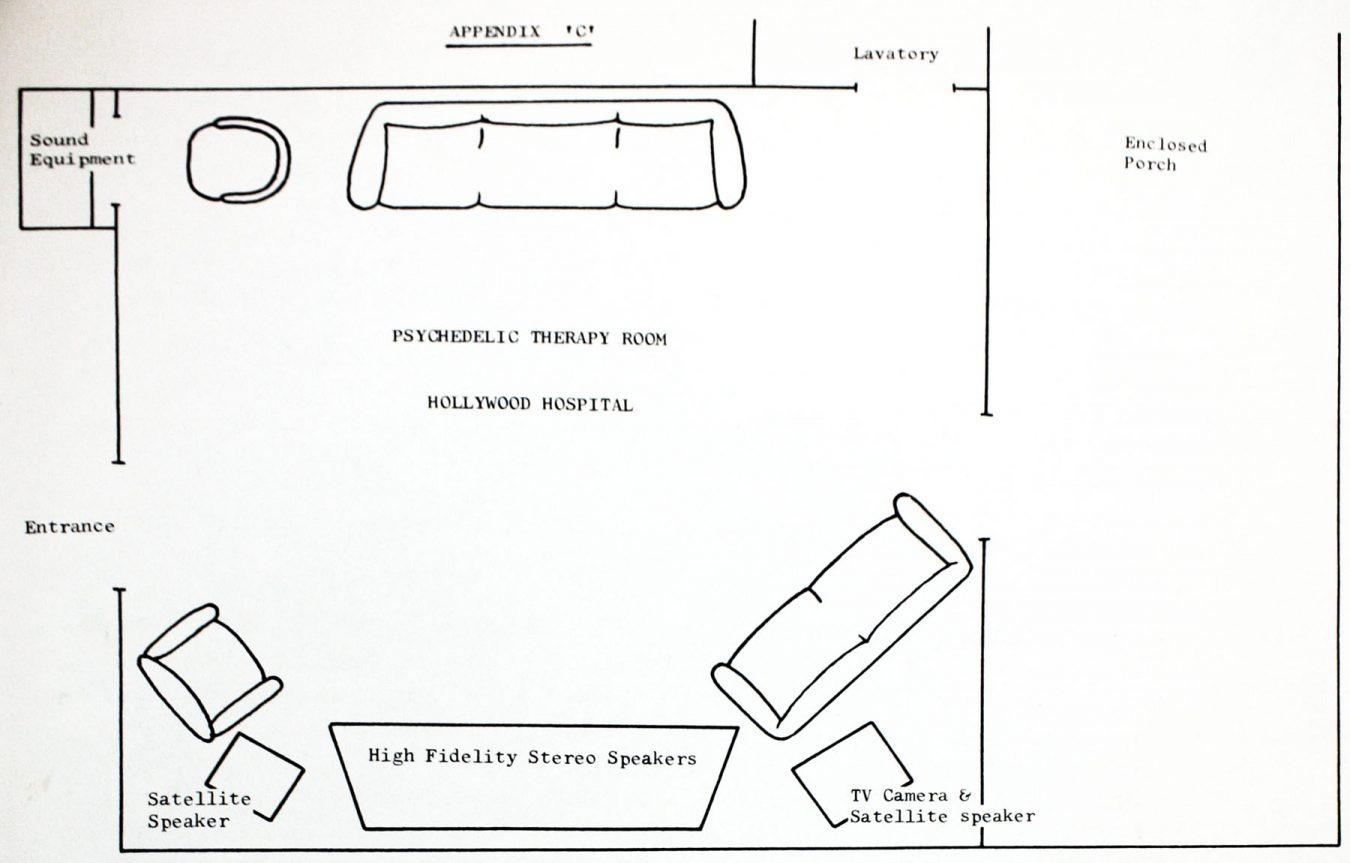
Therapists often played music during treatment sessions using the treatment room’s record player to reduce anxiety. There was a great deal of variety in the music selections – from Ravel’s “Bolero” to readings of “St. Paul’s Letter” – but Hollywood Hospital’s practitioners admitted that this aspect of treatment was not fully understood. Patients were also shown physical objects while under the influence of psychedelic drugs. For instance, they were encouraged to look at their reflection in a hand mirror, at a rose or other fresh flowers, or at pictures of their family or loved ones. These, according to Hollywood Hospital staff, were used to focus patients’ attention and to reinforce the idea that past experiences and feelings shape various aspects of human experience, such as one’s values, interpretations, and perceptions.
The goal of Hollywood Hospital’s psychedelic treatment program was for patients to experience abreaction, defined as “a total reliving of past events with a duality of intense personal involvement and detachment.”Observers at the time noted that this approach had the potential to greatly accelerate the treatment process beyond what was possible in conventional psychotherapy because experiencing “detachment” could help patients gain insight they could use in their everyday lives post-treatment.
Robert F. Kennedy Senior
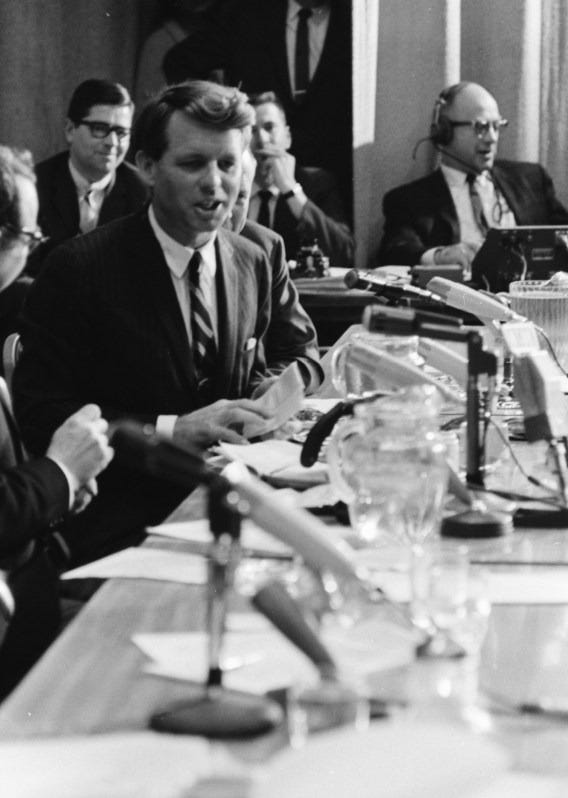
60 years ago this week, on May 24th 1966, Senator Robert F. Kennedy held a Senate hearing on the uses and abuses of LSD. The full name was ‘Hearings of the Subcommittee on Executive Reorganization of the Senate Committee on Government Operations concerning federal drug research and regulation of LSD’. You can listen to the hearings and read a transcript here.
The aim of the hearings was to respond to rising public and media concern about the use of LSD by college students, and to encourage a more coordinated federal response that would recognise, in the words of Senator Kennedy, that ‘there are great dangers of LSD; there are also tremendous possibilities for LSD’.
In his opening remarks, Senator Kennedy discussed how LSD has become ‘the subject of cover stories in national magazines and news documentaries on network television, of widespread public debate, and new legislative action within the states’...
In all of this, I do not believe there has been an adequate inquiry into the organization of the federal government to deal with LSD, and to whether the government has fulfilled its responsibilities in connection with research on LSD and regulation of its use…
Here is a drug which has been available for over 20 years. Research on its effect and its possible therapeutic uses has been going on for a long time. Yet suddenly, almost overnight, irresponsible and unsupervised use of LSD for nonscientific, non-medical purposes has risen markedly. Such use carries with it grave dangers. Panic reactions or temporary personality changes that cause a person to harm himself or to harm others while under the influence of the drug. Without careful psychological screening, the drug will be used by some who will suffer permanent damage as a result. In a word, what was an experimental drug has become, now, a social problem.
And as LSD has become a problem, the possibility has arisen that public reaction will discourage and dry up legitimate research into the therapeutic use of LSD. Experiments indicate that LSD may be useful in treating alcoholics, one of the largest groups of the handicapped, and has been helpful in some cases in adjunct in psychotherapy for mentally ill people. If we in the federal government allow these legitimate uses to be interfered with, the loss to the nation and potentially for the handicapped would be serious indeed
Much like his son exactly 60 years later, Senator Kennedy wonders how to coordinate the various parts of the federal government on psychedelic policy, especially the FDA, National Institute of Mental Health, and Veteran Affairs. He subjects the leaders of these organisations to questioning. Stanley Yolles, head of the NIMH, said:
No hallucinogen - LSD, mescaline, psilocybin, or dimethyltryptamine - should be administered except by a physician trained in its use and this should apply even if the current studies show LSD to be of value in the treatment of psychoneuroses, sexual perversion [ie homosexuality], frigidity, alcoholism, or other illnesses.
How, asks Senator Kennedy, did LSD suddenly become a ‘social problem’ without the government properly noticing or preparing? James Goddard, head of the FDA, replied:
I think it was the feeling of most people concerned, who were dealing with the drug on an experimental basis, that it was such an esoteric drug, that it would never come out in the open in terms of widespread use in colleges. What we are seeing now is that it has escaped from the laboratory.
How dangerous is it, asks Kennedy. Yolles of the NIMH replies:
We have no idea of how threatening it is, or how dangerous it is to any one individual at any one point in time. We know that there are certain individuals who have panic reactions, who become psychotic. And for a dangerous drug, even if one individual has that reaction, it’s a dangerous drug, but to state specifically what his chances are of having an adverse reaction is too difficult to [speculate?].
To which RFK replies, why don’t we know? Why, after 20 years of research, does the US government not have a clear picture of the range and prevalence of adverse events? Imagine what he’d say if he was around today, 60 years later, and we still only have a handful of papers on the prevalence of adverse events, despite the government now accelerating approval for these drugs.
Robert F. Kennedy Junior
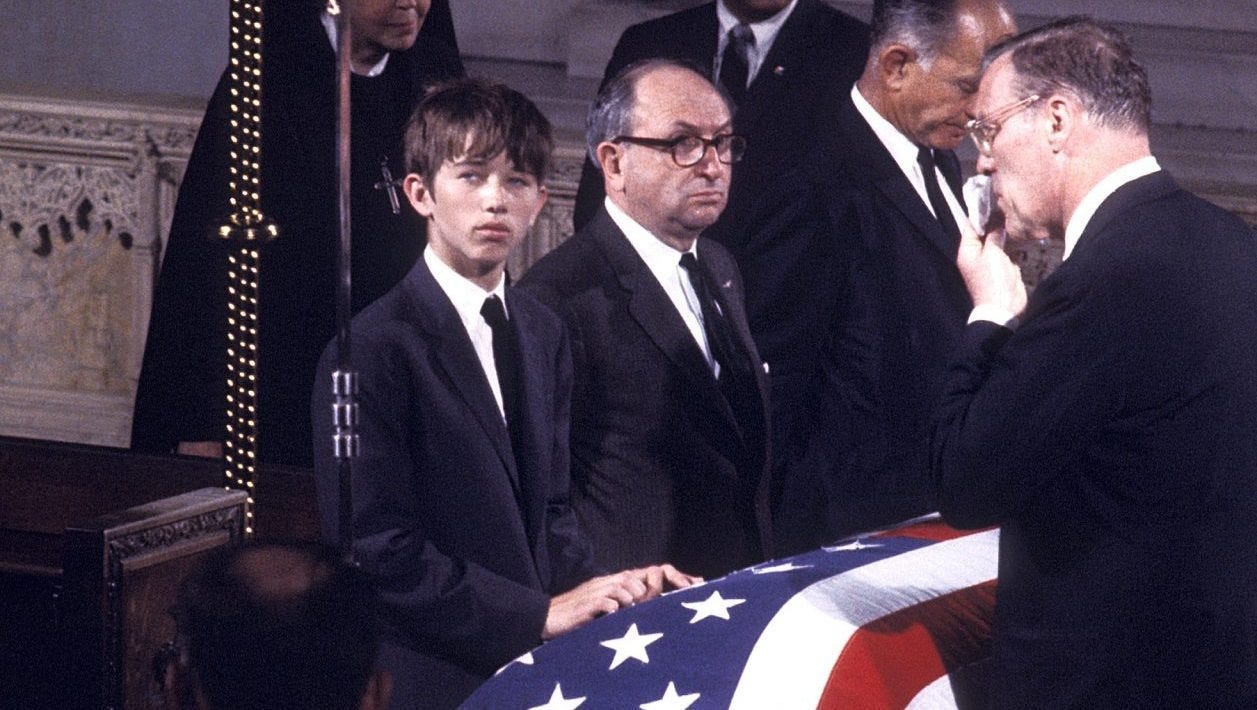
Robert F. Kennedy Junior first took LSD when he was 15, on July 4 1969, 11 months after his father’s assasination. He was offered a tab of Orange Sunshine, the famous LSD made by the Brotherhood of Eternal Love.
He writes in his book American Values:
Up until that point in my life, in conformance with King Frederick II’s proscription against inebriation among falconers, I had resolved never to use drugs or alcohol. In fact, I hadn’t even tasted coffee. However, I had recently gathered from my favorite comic book, Turok, Son of Stone, that hallucinogens might allow me to see dinosaurs, which I greatly desired. Jeff O’Neil assured me that this was a near certainty, so I swallowed the LSD, which more than delivered on his promise. Buildings melted like wax candles; trees bowed and swayed on a windless night; bright lights with long comet tails lent Hyannisport the cheery aura of Christmas in July.
He and his friends went to a diner while tripping…
