

Last week I gave a talk on psychedelics and ‘cultic social dynamics’ at Harvard, while Professor Gordon Melton, the leading critic of ‘brainwashing’ and a prominent figure in the ‘cult wars’ of the 70s, 80s and 90s, was sitting in the front-row, watching me.
It was an interesting experience, and interesting to talk to him afterwards. I came away with some understanding of how academic disagreements harden into ‘wars’ - with relevance for the ‘cult wars’ and the ‘memory wars’, both of which are in danger of re-igniting in psychedelic research.
Here’s my theory:
Academic disagreements turn into ‘wars’ when academics become ‘expert witnesses’ in multi-million-dollar law cases.
That’s what happened in the ‘cult wars’ of the 1970s to 1990s - ‘pro’ and ‘anti’ cult scholars became well-paid expert witnesses in several multi-million-dollar court-cases involving new religious movements / cults and ex-members, families and cult deprogrammers. And something similar happened in the ‘memory wars’ of the 80s and 90s.
Over multiple court cases, nuanced academic positions on complicated questions like ‘do people sometimes recover memories?’ or ‘do some groups sometimes use coercive tactics to limit people’s free will?’ turned into very black-and-white positions. Complicated questions became decided by judges and juries - not the scientific community.
Academic experts, paid by plaintiffs or defendants, understand their briefs and do not give nuanced views in which they recognize what is of value in the opposing opinion. They give simplified, black-and-white soundbites. And they make a lot of money from being expert witnesses - from $300 to $2000 an hour. This was and is the main livelihood of some academic experts.
Over multiple court cases, academic experts in both the ‘cult wars’ and ‘memory wars’ came to despise the other side - who they came to see as paid shills rather than scholars. They never met them for friendly conversations at conferences, they only ever saw them at highly-charged court cases.
That was something Professor Gordon Melton said to me, when I asked him about the cult wars: ‘No anti-cult expert ever properly investigated the groups they called brainwashing cults. That’s why we don’t like them - we think they’re shoddy scholars’.
I’m sure the other side has equally flattering things to say about him - that he was too close to the groups he researched, that he denied the validity of ex-cult-members’ testimonies, that he defended the Children of God and took money from them despite multiple testimonies of child abuse (some of them since proven in court).
But the polarisation of the past was ultimately bad for scholarship, because I suspect that, on both the question of recovery memory and the question of ‘brainwashing’, the answer is actually somewhere in the middle, and is best expressed not as a bald ‘yes’ or ‘no’ but rather: ‘possibly, yes, in some situations, with some provisos, but you need to be careful about overstating the case.’
This brings me to my talk last week. I gave a talk on ‘guruism and cultic dynamics in psychedelic organisations’ at a Harvard conference on psychedelic religion. I’m interested in how some individuals and groups sometimes use psychedelics to recruit, initiate, control and abuse other people. This has not been much covered in ‘cult studies’ - indeed, Professor Janja Lalich has said ‘most groups don’t use drugs, they don’t need to’.
As part of my research, I’ve been looking into the literature on cults from the 70s, 80s and 90s. This is like coming across the remains of a battle.
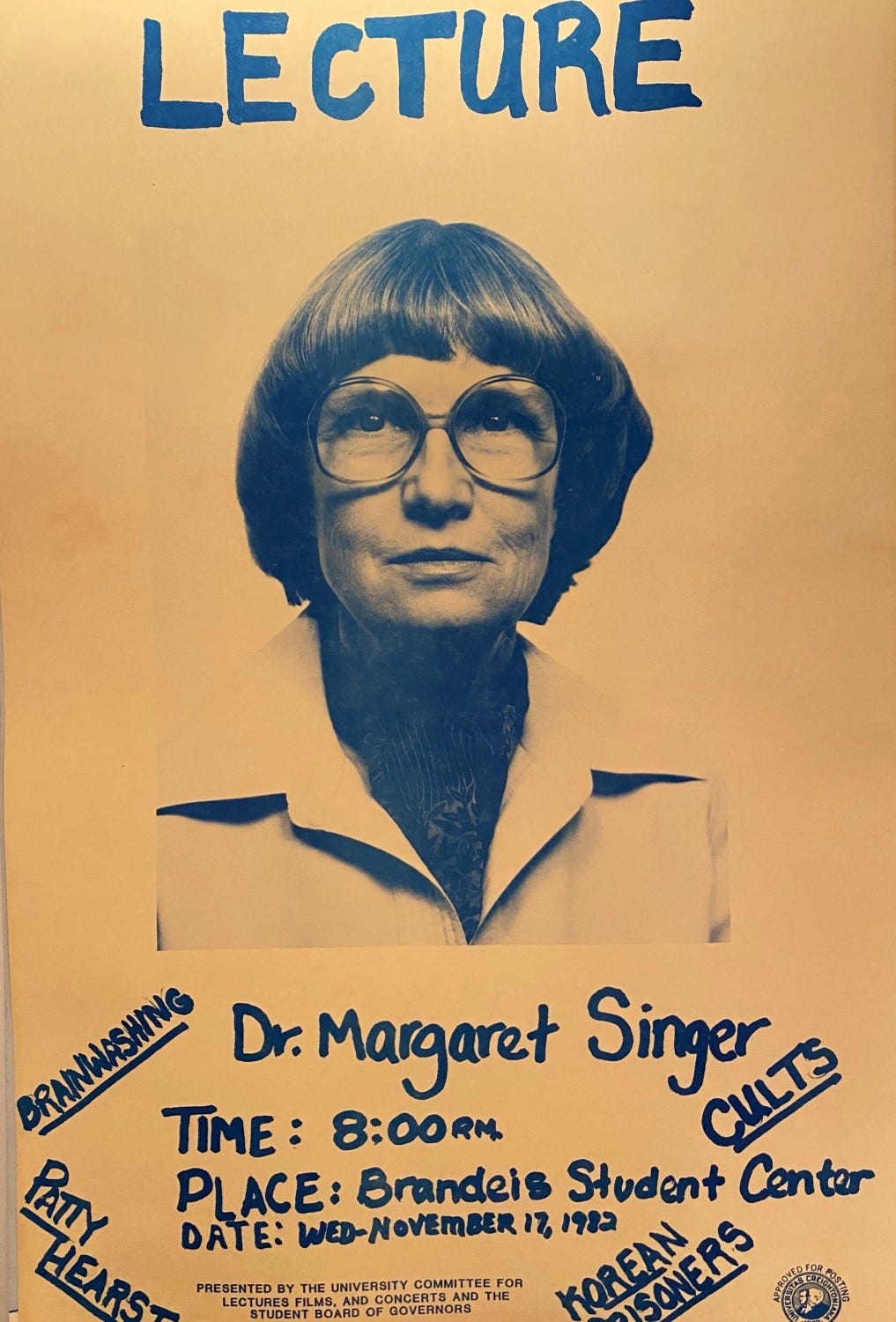
The ‘cult wars’ raged, from the 1970s to the early 2000s. On the one side were new religious movements (NRMs) like Hari Krishnas, Transcendental Meditation, Scientology, the Moonies and so on, and NRM scholars like Professor Gordon Melton, who were sympathetic to them. On the other side were ex-members, families with loved ones still in the groups, cult de-programmers (who were paid to kidnap people from cults by their families), evangelical churches, and ‘anti-cult experts’ such as Dr Margaret Singer.
It became so polarized that there is still no consensus over terms like ‘cult’ or ‘brainwashing’. Two scholars from either side of the debate - Benjamin Zablocki and Thomas Robbins - admitted:
the academic study of new religious movements has been sharply divided into two opposed camps in a way that is highly detrimental to intellectual progress in the field.
Why did it become so polarised? Zablocki and Robbins write:
Much of it has to do with a quartercentury of involvement by scholars from both camps in high-stakes litigation involving these religious groups. The law courts, with their need for absolutes and their contempt for scholarly ambivalence, helped to push both those who started with mildly positive dispositions towards cults into the extreme posture of the ‘cult apologist,’ and those who started with mildly negative dispositions towards these same NRMs into the extreme posture of the ‘basher.’
Scholars on either side became paid ‘expert witnesses’ in law cases that raged between cults / NRMs and ex-members, families, and de-programmers. Something similar, by the by, happened in the ‘memory wars’ of the 80s and 90s, with academics like Elizabeth Loftus or Bessel Van Der Kolk appearing as expert witnesses on either side of very acrimonious law cases between family members and therapists. Both sides came to despise the other side, and the debate hardened into a very black-and-white polarized situation.
In the ‘cult wars’, I think it’s fair to say that the NRM scholars won the legal battle. The theory of ‘brainwashing’ was rejected in several law cases, and Margaret Singer, who championed the idea of cult brainwashing, was ruled out as a ‘cult expert’ by a judge in the United States versus Fishman case of 1990 (Fishman was a former member of Scientology who sued it for brainwashing him).
Professor Melton told me: ‘Singer subsequently sued several of the leading NRM scholars for ruining her livelihood - she was making so much money appearing as an expert witness!’
Nonetheless, I think the anti-cultists may have won the public opinion war. It’s not as if the public obsession with ‘cults’ has lessened. Just go to Netflix and type in ‘cult’: Wild West Country, The False Prophet, The Doomsday Cult of Antares de Luz, Dancing for the Devil: The TikTok Cult, The Program, Bikram, The Orgasm Cult, Luz Del Mundo, Love Has Won, Escaping Twin Flames…there must be someone at Netflix just in charge of cult commissioning.
In my NGO, ex-members of psychedelic groups sometimes come to me and tell me they spent years in a group that they now feel is a cult. I don’t personally use the word ‘cult’ very often because I prefer to talk about ‘cult-like tactics’ rather than labelling an organisation a ‘cult’ in some essentialist way. It makes more sense to say a behaviour is harmful rather than an organisation. But the general public very much does use the word ‘cult’, all the time. It’s not going away.
That being said, ‘brainwashing’ was clearly an over-stated theory in the 1970s. It was not the case that people went to one Transcendental Meditation meeting and boom, their free will was robbed, they became a cult zombie, and their families would never see them again. I was initiated into TM. I paid £200 or so to get my mantra, and I never went back. I also studied meditation with the Shambala group when I was a university student (it’s since been accused of being a cult). I went a few times, never went back. That’s how it usually goes - most people who join spiritual groups leave after a short while, of their own free will.
Professor Melton’s great achievement, in the ‘cult wars’, was to de-legitimize the practice of ‘cult de-programmers’ - hired thugs who forcibly kidnapped people from spiritual groups, kept them in seclusion and tried to violently de-program them from their attachment to a group. It sounds like a barbaric practice, a pseudo-scientific and criminal million-dollar racket. It doesn’t happen any more, thanks to the work of Professor Melton and others.
However, do some individuals and groups sometimes use deceptive or coercive tactics to maintain control over others - such as lies, threats, love-bombing, public shaming, isolation from friends and family, intense peer group pressure, ridicule and ostracism, sleep deprivation, abuse, sometimes the use of drugs or intense meditation to indoctrinate, and so on? Well…yes!
And sometimes that creates a situation where leaders can entrap and abuse members for years - for sex, money, status or power. This has happened over and over and will keep happening unfortunately.
Some spiritual groups have more in common with criminal organisations like sex trafficking or labour trafficking rings, than they do with churches. I think religious scholars don’t always see this because they’re not really familiar with criminality, they’re familiar with ideas. As I wrote recently, some gurus are best understood as pimps: Charles Manson, Nicole Daedone, Kat Torres, Keith Raniere, Andrew Tate and others were basically pimps.

But one can have an overly-jaundiced view of spiritual groups in general and fail to recognize what attracts people to them. There’s a lot of positives people get from ‘culty’ groups - intense community, intense sense of meaning, extraordinary experiences, healing, and so on. And that’s what the NRM scholars want to emphasize - these groups are meeting a need. Ex-members may have fallen out of love with them and have a very negative view of them, but that’s not necessarily the whole story - there’s usually some existing members who think the group is awesome and the guru is just wonderful.
And there are plenty of ex-members of groups who think…it’s complicated. The best of times and the worst of times…
It’s not black-and-white, in other words. But unfortunately, it became a black-and-white highly-polarized subject because of court cases, and because of academics taking sides and taking money as ‘expert witnesses’. That made it impossible to reach an academic consensus.
That’s why I appreciated meeting Professor Melton at a conference, sitting down with him and exchanging friendly words. I am sure he disagreed with a lot of my talk - he certainly didn’t like me quoting Janja Lalich (a colleague of Margaret Singer’s). But it is useful for me, as a scholar, to try and understand his point-of-view and see what is of value in it. That’s how a nuanced consensus emerges - in collegial back-and-forths, rather than polarised positions in angry court cases.
There’s a lot of value in Professor Melton’s recent work on psychedelics, by the way. He has constructed the first database of psychedelic churches, over 200 of them. He’s working to find the common themes in their beliefs and theology (he thinks many of them are in the tradition of western esotericism, but that’s a topic for another day). He deserves to get funding for this work.
After the paywall, a couple of great resources for the brainwashing debate, more concerns about ketamine addiction and another fatality, new articles and a podcast on integration, the anti-AI violent backlash gathers pace, TMS-assisted therapy, and has Trump gone insane?
