

Hi readers,
I’m in the middle of a deep investigation into an ecocommunity in Costa Rica -formerly known as Earthwaking Village, now renamed Christian Villages - whose leaders were arrested last month for fraud. Former residents and investors say they were subjected to cult-like manipulation and pressure, and then ejected from the village if they were deemed to be demonic. The leaders deny the state’s charges and there is currently an attempt to negotiate a settlement with alleged victims who are claiming over $3 million in losses.
I’ve published the first part and second part of the story and am working on the third part, but need to wait a couple of days for an important interview. I don’t want my regular readers to think I’m slacking off or that I’ve lost focus on the psychedelic market just as companies are nearing FDA approval. So, before publishing the next Earthwaking installment on Tuesday, here’s a ‘Saturday brunch’ with an update on what’s happening in psychedelics.
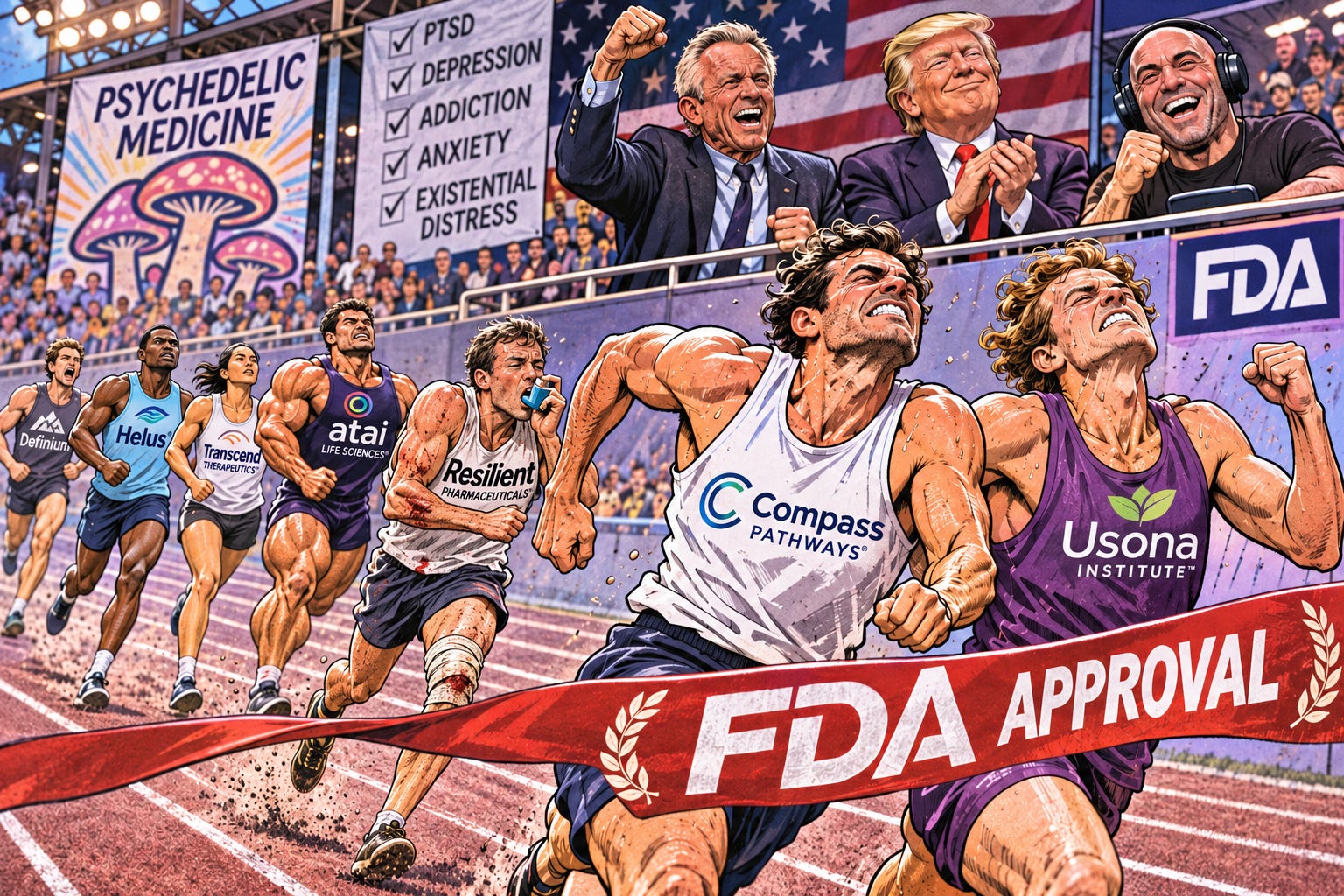
In the US, several psychedelic drug companies are hoping to get FDA approval for their treatments in the next 12 months, perhaps as soon as January. There’s a tussle between two of the leading candidates - Usona and Compass Pathways - who are both seeking FDA approval for psilocybin treatments and trying to be the first psychedelic company to get approved (if you don’t count Johnson and Johnson’s ketamine spray Spravato).
This week, a mysterious ‘citizen’s petition’ was filed with the FDA accusing Usona’s application of lacking long-term data and failing to clarify the role of psychotherapy in outcomes (Psychedelic Alpha reports on the petition here). The petition, which was written by a law firm for an anonymous client, echoes statements recently made by Compass’ management about Usona, but Compass denies any connection to the petition. It makes me laugh - it’s precisely the tactic left-wing non-profit Psymposia pulled to derail Lykos’ bid in 2024, and now it’s being used by corporations!
The beef between Usona and Compass goes way back. A decade ago, both of them were non-profits, then Compass became a for-profit and filed various patents, causing outrage among the psychedelic elite. Usona is still a non-profit - I can’t say much about them, they’re owned by a multi-millionaire biotech entrepreneur called Bill Linton, who barely ever gives interviews, but who I understand lives in a converted volcanic bunker in Wisconsin (just kidding).
Meanwhile Resilient Pharmaceuticals, formerly known as Lykos, was rejected by the FDA for its MDMA application in 2024, but then got bought by Musk sidekick Antonio Gracias and has re-filed its application. It is hoping for approval very soon as well. An FDA approval could attract some scrutiny both from the media and from the new Democrat-controlled Senate and Congress…let’s see.
What happens next for psychedelic companies depends partly on chaotic American politics. Since the mid-term Bluenami, Trump’s former chief of staff Susie Wiles has been booted out and replaced by lord of darkness Stephen Miller, who is close with RFK and presumably onboard with the psychedelic mission. RFK advisor Calley Means accused Wiles of being in the pocket of corporate interests in an explosive Joe Rogan interview. Wiles’ nominee for the head of the FDA, Heidi Overton, has been pulled and it’s not clear who will take the position. The FDA’s head of drug research, Mike Davis, has recused himself from the upcoming psychedelic decisions - he used to work at Usona. RFK’s HHS clearly wants to pre-empt any accusations of too cosy a relationship with the psychedelic lobby (or Big Acid as its known). RFK recently announced an ibogaine partnership with Mark Cuban and a $20 million HHS fund for psychedelic research. Meanwhile someone else died at an ibogaine retreat in Mexico, apparently - I’ll share more details when I get them.
US politics is chaotic, but it feels like psychedelics have crossed a threshold into the mainstream now, and many big pharma companies, like Danish firm Lundbeck, say they’re looking to buy M&A targets.
The two safety messages I’ve been highlighting are, firstly, that FDA approval will lead to a boom in underground usage, so safety measures can’t just focus on clinical access; and secondly, we need to develop well-researched protocols to help people who get destabilized.
Those messages are getting through to the media - NPR’s All Things Considered had a segment on people who experience long-term issues, including during clinical trials. The Free Press had a discussion on long-term risks of psychedelics between Coleman Hughes and Dr Mark Horowitz (the conversation is mainly on the risks of SSRIs). Even the Economist had an article discussing ‘ontological shock’ after psychedelics (something we have published two papers on).
This messaging is not doom-mongering - the non-profit I founded gets contacted by people who were destabilized after legal treatment in Switzerland or Australia, and they say their psychiatrists had no clue how to help them.
I’m part of a working group trying to figure out how to help people recover. One of our hypotheses is that prolonged post-psychedelic difficulties sometimes involve panic and a fixed belief that ‘I have permanently damaged my brain’. This belief lasts beyond the trip and leads to a vicious loop of hyper self-monitoring, catastrophising, doom-scrolling and social withdrawl, of the sort seen in prolonged somatic symptoms or prolonged health anxiety. People get out of the vicious loop through targeted psycho-education, cognitive reappraisal and acceptance, sometimes medication, and gradual re-engagement with external life and the things that give you meaning and joy. That’s one hypothesis for some forms of prolonged post-psychedelic difficulty, it doesn’t fit all of them by any means.
The thing I’m grappling with is that warning about the risks of any medication can lead to nocebo effects. Just as a lot of the impact of mind drugs like SSRIs is placebo, so a lot of the negative impact is probably nocebo. So how do we inform the public about genuine risks without causing unintentional harm? My conclusion right now is be as accurate as you can about how common or rare the risks are, and try to explain how people can recover.
After the paywall, psychedelic ego-inflation in Silicon Valley, AI cults, the UK prime minister on the ketamine epidemic, and the creators of The Witcher involved in an ayahuasca law case in Poland.
