

Four years ago, a small group of us started the Challenging Psychedelic Experiences Project, an NGO dedicated to learning more about post-psychedelic difficulties and what helps people recover. We’ve published 11 articles, two pre-prints, and have more papers on the way. When we started, psychedelic science and culture wasn’t even prepared to admit there was such a thing as ‘post-psychedelic extended difficulties’, now it’s widely accepted and there are many researchers working on the topic, trying to find out what helps people recover.
One of the great pleasures of this project, for me as a journalist and humanities scholar has been collaborating with psychologists, psychotherapists and psychiatrists on studies, which are published in scientific journals like Nature Medicine, PLOS One, Psychiatric Research and Clinical Practice, and the catchily-titled Current Topics in Behavioural Neuroscience.
Although I worked in a humanities department for eight years, to be honest I much prefer the ethic and vibe of science, and the idea that you can gather data, test your hypotheses, amass new evidence and thereby - maybe - help people heal.
At the same time, I still appreciate the things that humanities can bring to mental health research - ethical discussions, critical thinking around the field’s assumptions, historical research, and above all, stories and thinking critically about stories.
As a journalist and interviewer, I absolutely love to tell stories. I think it’s my superpower - the ability to interview someone, or interview lots of people, and shape all that data into a coherent, interesting and moving narrative.
Stories are important for how we think about psychedelics - not just qualitative research and thematic analysis, but actual flesh-and-blood stories of people’s non-linear journeys before, during and after trips.
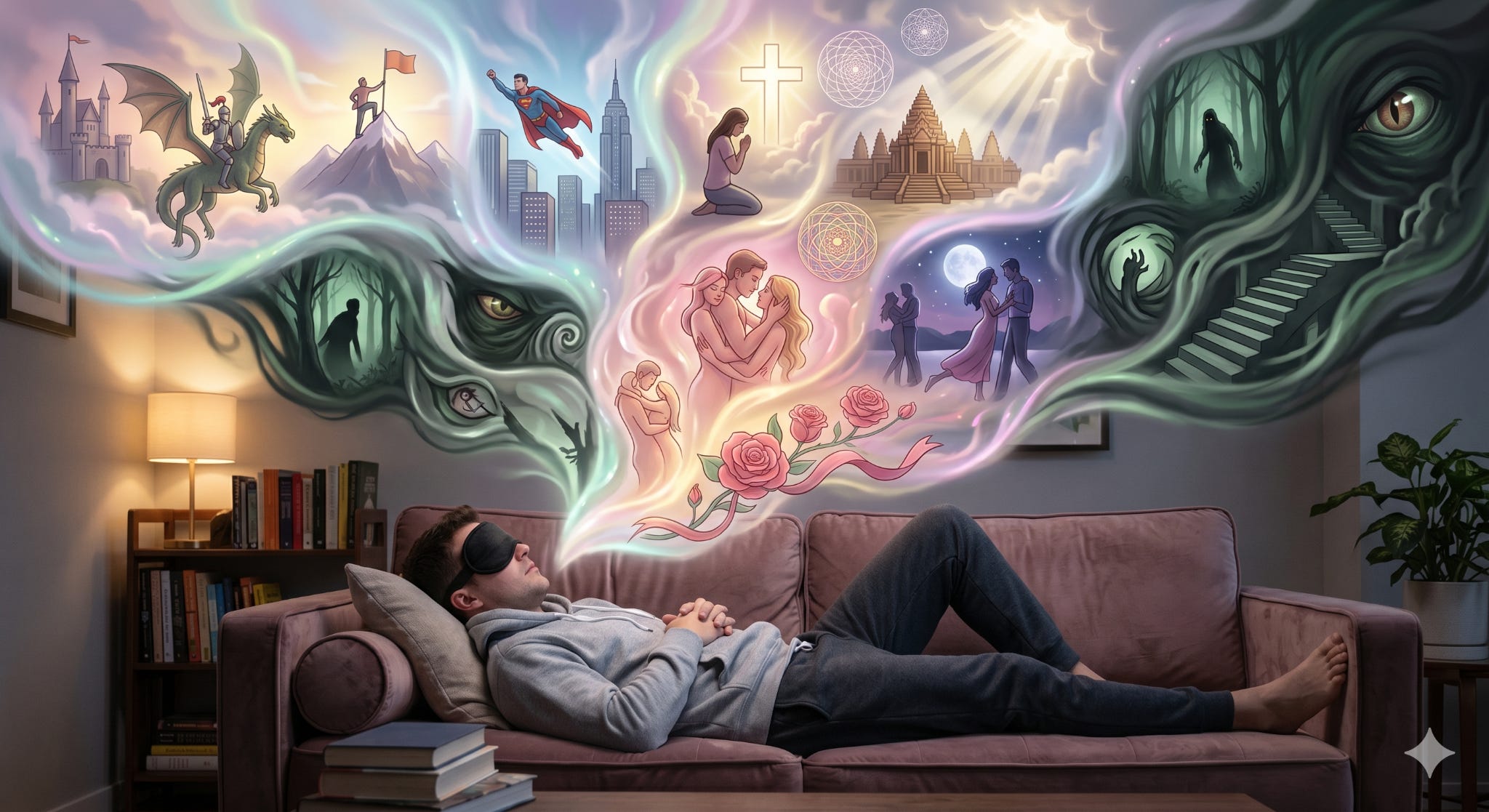
One way to think about psychedelics is as story-producing drugs. Louis Lewin, 102 years ago, called this class of drugs phantastica, that’s to say, fantasy-stimulating substances. They activate serotonin receptors, enhancing pattern-formation and pattern-recognition, they release dream-like symbols and archetypes from the subconscious (maybe), they provoke fresh perspectives (‘I became my grandmother, I became a tree, I became the universe’ and so on), they gives people this sense of the heroic self and their epic mission that one normally only finds in religion or fantasy-fiction. And they make people desperate to tell their story and spread the word.


The mind is a story-weaving machine. The mind on psychedelics is a story-weaving machine in over-drive.
Psychedelics, according to one leading explanation of how they heal, are both narrative-disruptors and narrative-creators. They can disrupt the rigid negative self-narrative that mentally unwell people are stuck in (‘I’m a loser’, ‘I am an addict’, ‘I am depressed and will always be depressed’, ‘the world has treated me unfairly’, ‘everyone hates me’ and so on), dissolve habitual self-beliefs, and create a space or aporia for new, more positive, more flexible narratives to emerge. And they also sometimes create new narratives - ‘you’re basically OK’, ‘the universe loves you’, ‘everything happens for a reason’, ‘your nasty father was doing the best he could’ and so on.
To take two examples, from a story I’m working on about Mormons and ex-Mormons and psychedelics:
Alf is a 35-year-old Mormon entrepreneur. He had a messy divorce and felt a lot of anger and bitterness. He had a profound MDMA experience in which he managed to see the situation from his ex-wife’s perspective and let go of his anger and bitterness. He also came to the perspective that everything happens for a reason, and all that suffering was helping him to grow. The MDMA experience gave him a new story, new perspectives.
Mark is a 38-year-old ex-Mormon. He was introduced to psychedelics at a difficult moment in his life - he had recently left the LDS church, and was coping with depression and suicidality, partly stemming from childhood sexual abuse. On his first MDMA experience, he saw his body from above, and it was filled with green ooze. He asked what it was, and a voice told him it was his anger. And then he was shown why he felt so much poisonous anger. He was shown everything that had happened to him, in vivid detail. He could even remember the smell of the man who had abused him. He saw all the pain he had experienced in various moments in his life. And the voice said ‘that’s why you’re so angry, because of everything that has happened to you, but you can let go of the anger now’. And then he saw all the green ooze leaving his body. That night gave him a new story, a new trajectory. ‘I have felt better ever since that night’.
As the Harvard psychiatrist Arthur Kleinman wrote in his 1988 book The Illness Narratives, illness and recovery are never just physical events, they are often stories, and a good healer pays attention to the story and listens to the patient. What story do they tell about the symptoms they experience and how it affects their relationships, work and identity? What story do they say about their ‘healing journey’, their path to recovery? What metaphors or symbols do they use?
The psychedelic anthropologist David Dupuis has described psychedelics as ‘super-placebos’, which does not mean they’re inert or sugar pills. What he means is they amplify the contextual effects that can help healing, such as expectancy, relationships, ritual and meaning. Psychedelics, he writes, can inspire a ‘narrative reframing’ and ‘identity reconfiguration’. I’m sure anyone who has taken or worked with psychedelics has seen this sort of narrative reframing and identity reconfiguration happen often, like it did with Alf and Mark.
But the narrative reconfiguration is not always to a more positive, resilient and flourishing story. If psychedelics act as super-placebos, they can also act as super-nocebos…
