

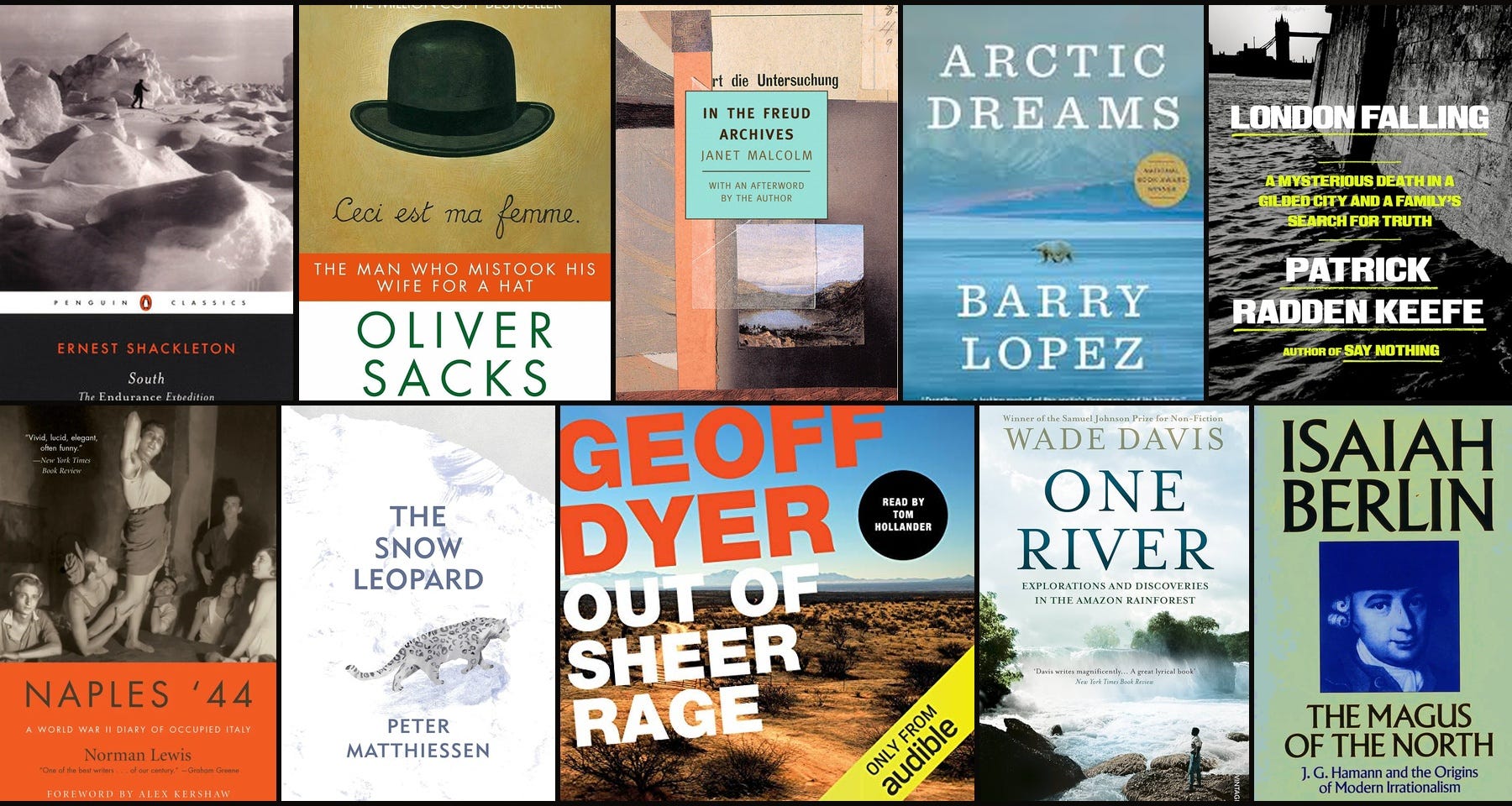
When I was 21, and trying to recover from post-psychedelic PTSD, I came across an odd little book in my local library called The Magus of the North: JG Hamann and the Origins of Modern Irrationalism by Sir Isaiah Berlin. I’ll bet you $10 no one else has read this book. But it had a profound influence on my life in three ways.
Firstly, the book introduced me to Isaiah Berlin and to the history of ideas, which is a field I love and am still engaged in. Secondly, it had a passage in it talking about ‘alienation’, and how people can become enslaved by their own thoughts and beliefs, which they raise above them as a sort of despotic God. This helped me realize, a few years later, that it was my own beliefs that were making my life a misery, and I had the power to change my beliefs. This realization, which then led me to CBT and Stoicism, was basically the lynch-pin of my life, a very simple realization which nonetheless contains the essence of human wisdom.
Thirdly, the book introduced me to an anti-enlightenment tradition, which I think is important for this era of Artificial Intelligence. Hamann, and other thinkers like Kierkegaard, Herder, William Blake and Thomas Traherne, were reacting against the Enlightenment tendency (in philosophers like Kant and Hegel) to transcend the particular, the local and the subjective to attain the Universal, Cosmic, Absolute, Impersonal, Objective and so on.
‘Truth is subjectivity’, Kierkegaard declared. Which is to say, we couldn’t and shouldn’t try to escape our particular, subjective life-view. Our view is always a view from somewhere, from a particular body, family, town, country, language and life-world. The Enlightenment, by contrast, tried to eradicate all particular differences and create a Universal, Objective, Cosmic worldview.
Hamann, Traherne and Kierkegaard were all Christian philosophers, and there’s something particularly Judeo-Christian in this celebration of the particular and subjective. In Hinduism and Buddhism, the particular self is an illusion and a death-trap. You transcend the individual self to attain Samedhi, Nirvana etc. In Judaism and Christianity, God created your individual soul, your particular spark of consciousness. You have a view that no one else has, and to meet the Divine you explore and celebrate the Divine in the particular You.
This is mystical experience not as ego-death and the realization of cosmic consciousness, but rather mystical experience as the particular, thisness, the meeting of the Thou and I, the incarnation of the Logos in the particular. This is a uniquely Jewish / Christian / Romantic perspective, I think.
And yes, as Isaiah Berlin explored in later books (particularly Freedom and Its Betrayal), this celebration of the particular, the local and the subjective can get into weird and dangerous territory - Romantic, irrationalist, nativist, ethno-nationalist, even fascist, or alternately, in the last few years, intersectional Woke, where every academic presentation begins with a description of your ‘positionality’, sentences like ‘as a brown-bodied gay man who has experienced trauma, let me tell you…’, and insistences that you could never possibly understand my perspective because you haven’t been in my body, therefore rational debate is impossible.
In other words, one can over-validate the subjective, the personal, the cult of me, and under-validate attempts at rationality, objectivity and universality. But during this moment, and the unstoppable rise of AI, I think it’s worth emphasizing the subjective, the particular, and the view from somewhere, because it points to an important difference between humans and AI.
Humans write and experience the world from a particular view - a particular body, place, family, time, personal history, country and language. It’s a particular view and voice, a view from somewhere.
AI, by contrast, is not a particular voice. It is every voice. It’s not a view from somewhere, it’s the view from everywhere, or nowhere. It is the flattening of individual difference into the cosmic noosphere soup. AI is great at replacing objective-sounding language. It is very good at academic writing, and already does it better than academics. But it can’t (yet) convincingly replace individual authorial voices. It is the Auto-Tune of authorial voice, which is why, no matter whose authorial voice you ask AI to mimic, it always ends up sounding the same. It’s OK to use AI to work out your thoughts or to communicate with others as a convenience, I do it all the time and am a big fan of AI-assisted research and writing.
But be careful - you’re basically auto-tuning yourself and letting a machine take your God-given voice.
When I read Isaiah Berlin, or Patrick Radden Keefe, or Janet Malcolm, or Tom Wolfe, or Jon Ronson, or other of my favourite literary non-fiction writers, what I love is their voice, the view from somewhere. That’s why I promise never to use AI to write my Substacks - because those of you who are kind enough to pay me are paying me for my voice, my view from somewhere.
With that, here’s a list of some of my favourite literary non-fiction books, along with your favourite non-fiction books as well. Here’s to the views from somewhere, those particular books by particular authors on particular topics that you read and never forget. Each of these books is a whole world, and could only have been written by this one particular author.
My faves:
Liar’s Poker by Michael Lewis
Imperium by Ryszard Kapuzinski
Naples 44 by Norman Lewis
The Gnostic Gospels by Elaine Pagels
Say Nothing by Patrick Radden Keefe (also his new book London Calling)
More after the paywall, plus some of your top picks
