

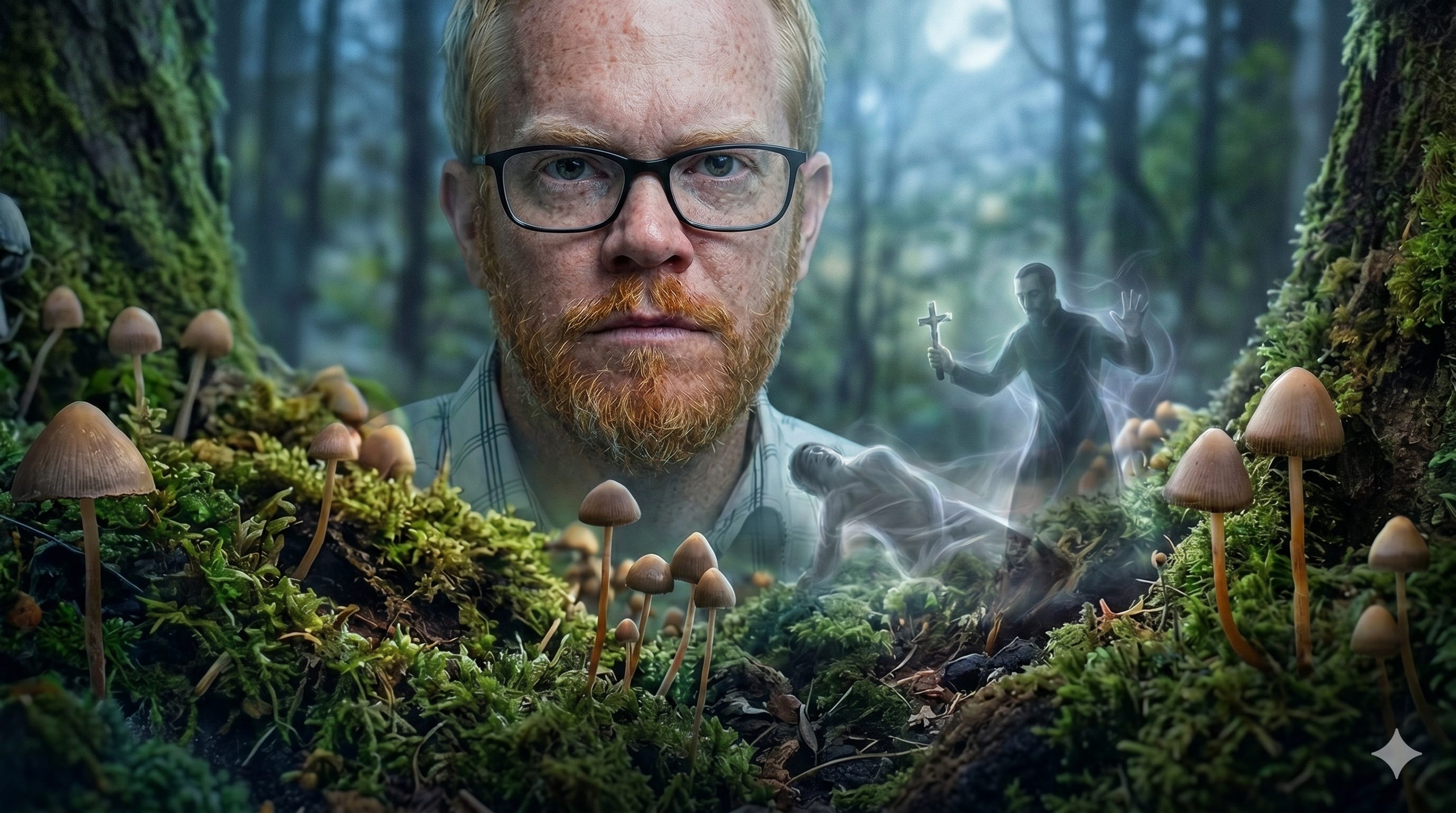
Dr Sean Tobin is a Catholic psychologist who works on exorcisms for his local diocese in the US, and who recently spoke at a Vatican gathering of 300 exorcists, where he suggested the Church should integrate therapy, and specifically Internal Family Systems parts work, with traditional exorcism. We also discusses his positive views on psychedelics. He’s an interesting figure with a strong online presence - 80,000 Substack readers and 80,000 YouTube followers, which just goes to show that exorcism is having a moment.
Let me just state my own positionality before the interview. I am agnostic about the existence of demons. I genuinely don’t know if they exist or not. I’ve criticized IFS for smuggling the idea of ‘unattached burdens’ (or demons) into secular therapy - I think that’s potentially unethical and harmful if a client comes to an IFS therapist for secular therapy and is suddenly told they may have a demon inside them. I’ve come across accounts of this occurring, and you can imagine that could be distressing and iatrogenic. I don’t think Dr Tobin is necessarily doing this – he’s contacted by his local diocese to support people who believe they are possessed, so it’s already explicitly a Catholic exorcism framework.
This whole topic is quite ethically tricky, as even discussing demons could be iatrogenic, if it encourages people to adopt the belief! It gets trickier in the world of plant medicine…I can think of various different scenarios, for example:
A person has a psychedelic experience and comes away feeling they have a negative entity attached. They seek help for this from a therapist.
Same as above, but they seek help for this from a shaman or exorcist.
A person goes to a psychedelic retreat for healing and is told they have a demon attached to them by the facilitator or shaman during the retreat.
A person goes to a therapist for support after a retreat and is told they have a demon / unattached burden attached to them.
These are different scenarios requiring a high level of tact and discrimination from the therapists and shamans, and there’s a significant risk of clumsiness or exploitation. We can make one ethical distinction between (1,2) and (3,4) – in the first two cases, the client already believes they have a demon within them and are seeking help for this. In the second two cases, they’re told they have a demon within them. Scenarios (3) and (4) are potentially more harmful and ethically dubious - there’s a higher risk of the therapist or shaman imposing their worldview onto the client in a way that causes distress.
In general, my ethical rule-of-thumb is: don’t impose your religious worldview on a client, especially while they’re in a suggestible, altered-state, without informed consent. If you have a particular religious world-view that informs your healing practice (such as a belief in demons, or Starseeds, or Marxism-Leninism) tell clients clearly and early on so they can choose if they agree with that frame or not, as otherwise there’s a risk of unwanted epistemic contamination in the psychedelic experience.
Of course, there may also be an ethical difference between scenarios (3) and (4) in that it’s less surprising for a shaman to tell you have a demon within you than for a therapist to do that. Demons or negative entities play a central role in the shamanic worldview, so a client in a way should expect it might come up in their diagnosis, just like the Oedipus Complex might come up if they see a psychoanalyst, or ‘parts’ will probably come up if they see an IFS therapist.
I see the ethical value in keeping domains and worldviews separate – keeping therapy separate from religion and spirituality. In practice that is sometimes hard, especially in psychedelic healing. But at the least, healers can try and be upfront about their framework and metaphysical commitments.
Jules: Tell me a bit of your origin story.
Sean Tobin: I grew up in an Irish Catholic family, starting in Quebec, then Montreal, and then upstate New York. I struggled with depression early on. I just felt very disconnected from my family, my parents especially. By the time I was nine or 10, I didn’t believe in God, and spent my high school and early college years going deep into determinism and atheism.
Were your family religious?
Not really. My mom was more so, but it was easy for me to brush that off because I thought she was a bit strange socially. My parents separated at a young age. I think the place for spirituality was really lacking in my life, I was never introduced to prayer, it seemed like some words that you ramble, but there was not much of an experience connected to it. And relationally, there was no grid, because I didn’t feel very connected to my parents.
But I went on a journey when I was 21, a trip with my dad, where I also encountered some charismatic Catholic priests. My sister was going to a college called Franciscan University of Steubenville, she was doing a summer abroad in Austria, and so I went to go visit her, and on that trip I was challenged by some of these priests, and they prayed with me - one of them even he prayed in tongues over me. It did something inside of me that made me weep, and all this hatred and pain started coming out.
Shortly after meeting them and going home, I was still wrestling with what to believe, still hanging out with friends that were regularly drinking, smoking pot, doing the young adult stuff. I went through a phase where I broke up with a girlfriend, quit some jobs, flunked out of school and college for the second time, and I was just really depressed, even suicidal, and I ended up trying to pray on my own one night. I woke up in the middle of night speaking in tongues and hearing an interpretation in English - it was all these praises of Jesus. I was just completely wrecked, thinking, ‘if you’re real, I give my life to you, I don’t really know how to live’. So, yeah, I surrendered to that experience and that encounter.
I should backtrack on this too. When I was a teenager, I tried mushrooms once or twice, just as a fun recreational thing, but I always found I would get really existential or spiritual, where I felt connected to the trees, and I would think about life’s higher purpose. When I was praying to God, I tried to recall that sense of connectedness that I had on mushrooms, to remember there was a part of me that was deeper than just being in the moment. I think that mushrooms gave me a first tangible experience of a spiritual life.
And that deepened to the point where you were training to be a priest?
Yeah, my conversion experience was such a shift for me that it was hard for me to imagine doing anything else [than train to be a priest]. I went to school for philosophy and theology.
At a seminary?
Yes, the same one that my sister went to, Franciscan University. For two years I joined a religious community called the Intercessors of the Lamb. It was an incredible experience. I basically was a monk and spent five hours a day in meditation. I had stopped taking all substances, I was trying to live a purer life, but I was still meditating a lot, and I had some pretty profound mystical experiences.
I ended up leaving the religious community, and discerning that it was maybe best to go back to finish school. The community was new and was going through a governance change, so I decided to go back to school, and that’s how I eventually found my way into graduate psychology, and doing a doctorate in that. I guess the unique thing for me was, since I had been in religious life, I was really fascinated by the idea of demonic possession, and how that might affect mental health.
Why?
Simply because it seemed obviously relevant to me studying psychopathology, when I’d read passages of the Gospels where Jesus healed people (like the epileptic boy or schizophrenic man) by casting out a demon. There had to be some overlap. And that differential diagnosis between the two seemed one of the most important things to get right, believing in demons as I did.
From what I’d read in scriptures, it seemed to me like the people that Jesus was healing often had psychiatric conditions - an epileptic boy, a man who seems schizophrenic, things like that.
You mean that they weren’t possessed, they actually had psychiatric problems…or more both / and?
Both / and. He showed incredible discernment to identify the root cause, but his approach was always relational and not superstitious. It was still connected to humanity. So I ended up doing a deep dive into the databases.
What databases?
There are a lot of anthropological and scientific studies, from psychiatrists to sociologists to anthropologists to even theologians, but I tried to stay away from the theology a bit, because I figured they’re biased. But yeah, trying to get as much from the scientific databases as I could.
Is that what you did your PhD on?
My PhD was just in clinical psychology, with an emphasis in psychoanalysis. My dissertation title was ‘Exorcism, deliverance, and psychotherapy: a critical literature view from a Catholic Christian perspective’. And what I ended up finding was that the existence of demons is something that requires faith, you can’t prove it. It’s in some sense a subjective interpretation of something someone’s perceiving. But I also found that there was a lot of psychology that is also part of that experience for people, and the tendency is to make it either spiritual or psychological, but I was finding that it was both.
How so?
Well, that there’s often a psychological woundedness, vulnerabilities or traumas that end up becoming the context for a lot of the affliction, also sometimes the demonic stuff can be a metaphor, making a psychic wound or internal struggle more concrete and external, or even sometimes people can become demonized almost as a secondary gain in order to get some kind of gain, like a relationship with a father figure called an exorcist.
In other words, being possessed provides a structure for their suffering.
Yeah, a narrative outside of themselves, something that they could maybe redeem. That’s not to say there isn’t a demon in place, but that there’s also more in the picture. So I saw how the psychological and the spiritual went together, and it wasn’t one or the other.
So you argue that demonic possessions could be a mixture of the psychological and the spiritual?
I would say it always is. That was the conclusion I came to. I started being referred people by my diocese who were reporting struggles with demonic phenomena. I was sent people who needed exorcisms, and in order to get an exorcism now in the Catholic Church, you need a thorough review by a psychological professional to make sure that it’s not schizophrenia or something like that.
Wow, so that’s what you are doing?
Yes, I started doing that, as well as working with them as a therapist. But I started to see people set free or healed just by a different way of sitting with them and their struggles. So, to get theological for a moment, there’s a scripture passage in First Peter [that’s a letter in the New Testament] it’s one of these classic passages on the devil, and the scripture is that ‘the devil prowls around like a roaring lion seeking someone to devour, so resist him solid in your faith’. That image of a lion prowling around, hunting us, it gives people a certain fearful image of this predator.
But the irony of that passage is a roaring lion is a terrible prowler, he reveals where he’s hiding, so it’s almost like an attention grabber. And that is what I found – the demonic manifestation is often revealing a hidden place of influence in someone’s life. So I learned to sit with it differently, where to me it helped reveal those areas of inner conflict.
So the roar is actually a signal of inner wounds.
A signal, exactly. So, whether it’s someone who the demons are speaking through or causing them to move around, or whatever, it’s an attention-grabber. Today there’s a lot of work that we do in psychology with Internal Family Systems and parts work.
I’m familiar with IFS.
And oftentimes we’re stuck in a pattern of this deep inner conflict in our parts, and my view of the enemy is he’s a divider - the word diabolic means to throw between, to come between with lies and slander.
Oh, really? Cool, I didn’t know.
What the devil does is he will exacerbate division, he’ll suggest to one part to put it against another part, so he helps create more of a pattern of inner division. It can be taken to a spiritual level, but in some ways it’s still inner conflict between parts.
So you have a particular role than within the Catholic Church, as a psychologist, which is that, if someone wants an exorcism, your job is to say ‘this is a mental illness, while this is demonic possession’. But if I’ve understood you right, in practice that’s challenging, because it’s often a bit of a mix, so it’s quite difficult to say ‘this is depression but that is demonic possession’. And it also sounds like the tools you might use in one or other scenario might not always be so completely different. You’re talking about sitting with them, listening to them, even sitting with the demons in a way. I can understand why church and therapy might want to keep these things separate - they’re different worlds, different professions, different ethics. But what you’re saying is, in practice, sometimes it’s a bit blurred.
Yeah, I think we make a claim that it’s easy to separate the spirituality from the psyche, but psyche means soul. We experience so much of our spirituality through the psyche. Since the garden, the belief is that the enemy has only ever influenced us by way of suggestion, the battle is really in the mind.
In beliefs and attitudes.
Right. And if I can engage with that part while allowing the person more deeply to connect with God and to reconcile some of these inner conflicts, then their spirit almost comes alive and gets reconnected in a way that drives out the Enemy. I don’t think that the Enemy needs to be so much commanded to leave as much as sometimes people need to hear those words if they need to feel rescued or something. But it says that when the devil waged war against God and his angels, seeing that there was no longer a place for them, the devil and his angels were cast out. So it’s like, when a place is full of light, there’s no place for darkness. I really focus on filling those areas with light, rather than expelling the darkness.
How long have you been working on exorcisms?
About seven years.
Can you think of a good example or case study. Because I think most people’s image of an exorcism will be from The Exorcist.
I could tell you the first woman that I ever saw.
After the paywall, parts work at the Vatican exorcism gathering, plus what Sean thinks of psychedelic medicine, and do psychedelics open people up to the demonic, in his view.
