

I once knew a lady who organized boutique treasure hunts as a side hustle, while doing a PhD in English Literature. She and her team would be hired by a client, and they would prepare the treasure hunt, leaving clues around a location, and the clients would follow the clues and discover magical scenes, sometimes with actors or musicians playing roles to point them to the next clue. The idea was to conjure up a sense of enchantment, somewhat along the lines of John Fowles’ The Magus. Later on, she became a charismatic Christian and embraced the idea of a universe brimming with the supernatural. She had a profound need for enchantment in her life, and only charismatic Christianity could satisfy that need.
Many humans have this deep need for enchantment. It’s closely allied with our need to alter consciousness. As a species, we are easily bored with the mundane, and want to be transported. Two of the main methods we use: drugs, and stories. Gather round the campfire, chew on some leaves, and listen to a story-teller conjure up another world.
This basic human need goes wrong when a person uses drugs, or stories, to habitually avoid reality and becomes lost in delusion. Both drugs and stories can heal, or they can become addictive labyrinths from which we cannot escape. Stories, like drugs, require discrimination and harm reduction.
Carlos Castaneda, the author of the Don Juan books and the subject of a new biographer by Ru Marshall, wove enchanting stories and millions of people fell for them. Some people really fell for them and followed the path he laid down, crumb by crumb, until they realized they were lost in his labyrinth. He was a world-class spiritual fabulist, the latest in a long line from Joseph Smith to Madame Blavatsky, from L Ron Hubbard to contemporary shamanic hucksters like Simon Buxton or [name deleted on legal advice]. The history of religion is, to a large extent, the history of spiritual fabulism. Give us an enchanted fairy-tale, a treasure hunt to follow, and we are hooked.
On mythomania or spiritual fabulism
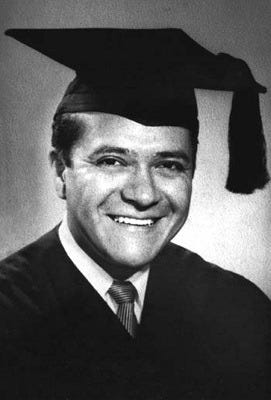
Carlos Castaneda was a young, affluent, educated Peruvian who went to study in Los Angeles, initially studying creative writing at Los Angeles City College, then transferring to UCLA to study anthropology. He was a bullshitter from the start - he changed his name (it was Carlos Araña originally, which means ‘Carlos the Spider’), sometimes claimed to be Brazilian, and left a daughter in Peru who he never mentioned or supported.
At UCLA he was particularly influenced by two professors: first, by a sociologist called Harold Garfinkel. He had a cult of personality around him, and only worked with certain special students, who he sent out into the world to do ‘breaching’ experiments. They would be instructed to do weird shit and see how people around them react when social norms are breached. Some would later wonder if the entire ‘Don Juan’ hoax was one long breaching experiment.
Secondly, there was a UCLA anthropology professor Clement Meighan, who told his undergraduates he would give any student an A if they managed to interview a real, genuine Indian. Young Carlos came back from this assignment with an extraordinary story - he had met and interviewed a Yaqui brujo (sorcerer) in Mexico called Don Juan, who had taken him on as his sorcerer’s apprentice! Carlos had supposedly travelled down to Mexico in between UCLA classes and undergone this life-endangering apprenticeship, smoking mushrooms, taking datura and peyote, undergoing various magical trials, being favoured by the god of peyote, ‘Mescalito’, and even turning into a crow!
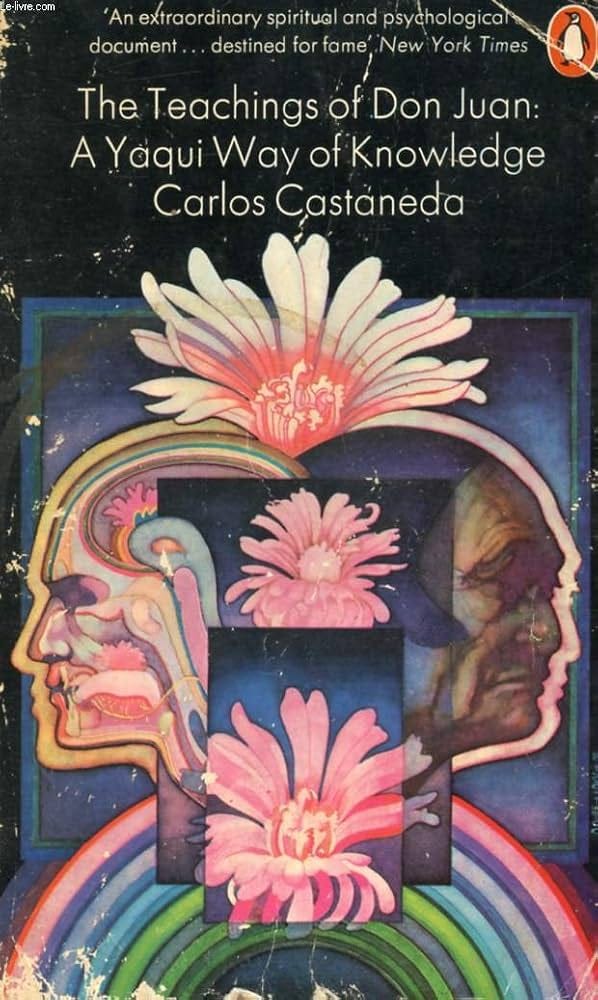
It was a tall-tale perfectly suited to hook a certain sort of liberal white person who credulously romanticizes non-white cultures. His undergraduate thesis was published by University of California Press as The Teachings of Don Juan. It’s a good read, which takes the boring genre of student anthropology essay and turns it into a heroic fantasy of magical apprenticeship that’s straight out of H. Rider Haggard or Edward Bulwer Lytton. Carlos appears as the hapless representative of arid western academia, utterly clueless before the real master, Don Juan, who is constantly swatting away Carlos’ naive questions:
“Are you going to use witchcraft?” I asked with great expectations.
“Don’t be silly. No witchcraft would ever work on her. I have other plans! I’ll tell you about them some day.”
“Can your ally protect you from her?”
“No! The little smoke only tells me what to do. Then I must protect myself.”
“How about Mescalito? Can he protect you from her?”
“No! Mescalito is a teacher, not a power to be used for personal reasons.”
“Is Mescalito God- the only God? Or is he one of the gods?”
“He is just a protector and a teacher. He is a power.”
“Is he a power within ourselves?”
“No. Mescalito has nothing to do with ourselves. He is outside us.”
“Then everyone who takes Mescalito must see him in the same form.”
“No, not at all. He is not the same for everybody”
You can see the format - Carlos asks a question ‘is it X?’ and Don Juan replies ‘no, it’s Y’. His answers give the impression of this vast, coherent and hitherto secret body of knowledge about a separate magical reality. And Carlos the undergraduate just happens to have been handed the key to the secret garden. It’s as if an owl had flown into his bedroom with an invitation to Hogwarts.
Institutionalized fabulism
If you want to get people to accept a tall story, there are various ways you can increase the chances they will accept it. One way is social proof - get others to say they believe it, especially if the others are famous. Another way is institutional proof - somehow get your story imprinted with the legitimacy of a well-established institution, like the University of California. The University’s UC Press published The Teachings of Don Juan: A Yaqui Way of Knowledge in 1968 and it was soon snapped up by Simon & Schuster. Carlos then went back for more teachings from Don Juan, which he recounted in A Separate Reality: Further Conversations with Don Juan (1971); Journal to Ixtlan: The Lessons of Don Juan (1973) and so on. Journey to Ixtlan was accepted by UCLA as Castaneda’s PhD thesis.
Such extraordinary books, arriving with the official imprimatur of the UCLA anthropology department and the glowing approval of authorities like Michael Harner and Theodore Roszak, naturally caught the attention of all the young hippy undergraduates, themselves experimenting with mind-altering substances. Like Castaneda, the young hippies were all too ready to reject mainstream western civilization and search for alternative father-figures at the fringes. Don Juan reportedly inspired George Lucas to invent Obi Wan Kenobi, and Castaneda’s tales were also gobbled up by Oliver Stone, David Bowie, the Eagles, Bob Dylan. The adventures of Don Juan and his hapless apprentice made Simon & Schuster a fortune - eight million copies sold worldwide.
But slowly, sceptical voices began to be raised.
